
 |
 |
 |
 |
 |
 |
 |
 |
 |

 |

Cape Canaveral, Florida (AFP) Nov 4, 2010 NASA cleared the Shuttle Discovery to launch Thursday to the International Space Station, but the US space agency warned of another delay if weather did not improve. Mission experts agreed on the launch attempt after a close study of the latest electrical glitch found that a circuit-breaker was the origin of a cockpit problem, not the main engine controller which would have been more serious. But after three postponements so far to Discovery's final flight before it is retired, NASA experts said poor weather could push back efforts again. They said they would review conditions early Thursday ahead of the 1929 GMT launch. "From a vehicle prospective we are ready to go," said mission management team leader Mike Moses. "The weather still looks pretty bad for tomorrow," he added. "There's a chance we'll decide not to spend one of our (launch) opportunities." The weather forecast at present calls for only 20 percent favorable conditions for launch. A green light from the mission managers would begin shuttle fueling operations, which normally take three hours and are scheduled to start at 1005 GMT. The launch window closes Sunday. The next window for the mission would come on December 1 and last only a few days. Discovery's 11-day mission, originally scheduled for November 1, was delayed twice for an engine pressurization problem and again on Tuesday for an electrical malfunction of a circuit-breaker in the shuttle's cockpit which failed to turn on as expected. While the latest glitch with the back-up controller for shuttle engine three was not considered a major problem -- the breaker worked after several tries -- NASA engineers wanted to understand its causes should it malfunction again during takeoff, Moses said. NASA concluded the problem was residue buildup on the breaker switch. Moses described it as an "anomaly," and said "we are good to fly." Discovery's all-American six-member crew, including female mission specialist Nicole Stott, will deliver a pressurized logistics module called Leonardo, which will be permanently attached to the space station to provide more storage space. The shuttle will also bring Robonaut 2, the first human-like robot in space and a permanent addition to the orbiting space station, as well as spare parts. Two space walks, for maintenance work and component installation, are scheduled. The flight to the ISS is the fourth and final shuttle flight of the year, and the last scheduled for Discovery, the oldest in the three-shuttle fleet that is being retired in 2011. "Discovery is not going out easy, she is giving us a little bit of trouble but that is fine, she will fly perfectly when she does," said launch director Mike Leinbach. The three US shuttles -- the other two are Atlantis and Endeavour -- are due to be sent off to become museum pieces after a final shuttle mission to the space station in late February. That means Russian Soyuz spacecraft, a modernized version of which recently dropped off three fresh crew members to the ISS, doubling the crew to six, will for several years be the only vehicle for transporting humans into space. However, NASA's recently approved 2011 budget has left the door open to an additional shuttle flight in June.
Share This Article With Planet Earth
Related Links Shuttle at NASA Watch NASA TV via Space.TV Space Shuttle News at Space-Travel.Com

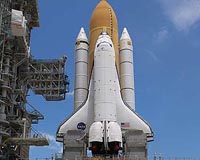 Boeing Helps Prepare Space Shuttle Discovery Final Payload
KSC FL (SPX) Nov 03, 2010 Boeing engineers and technicians are supporting Space Shuttle Discovery's final mission, in part by processing the shuttle's payload, which includes the last U.S. pressurized element to be delivered to the International Space Station (ISS). Discovery will launch on its final mission to the ISS from Kennedy Space Center on Nov. 3. Boeing built Discovery nearly 30 years ago. Since then, the ... read more |
|
|
| The content herein, unless otherwise known to be public domain, are Copyright 1995-2010 - SpaceDaily. AFP and UPI Wire Stories are copyright Agence France-Presse and United Press International. ESA Portal Reports are copyright European Space Agency. All NASA sourced material is public domain. Additional copyrights may apply in whole or part to other bona fide parties. Advertising does not imply endorsement,agreement or approval of any opinions, statements or information provided by SpaceDaily on any Web page published or hosted by SpaceDaily. Privacy Statement |


 del.icio.us
 Digg
Digg Reddit
 YahooMyWeb
 Google
 Facebook


