
 |
 |
 |
 |
 |
 |
 |
 |
 |

 |

Washington DC (SPX) Jan 07, 2011 Is the expansion of the universe accelerating for some unknown reason? This is one of the mysteries plaguing astrophysics, and somewhere in distant galaxies are yet-unseen supernovae that may hold the key. Now, thanks to a telescope calibrated by scientists from the National Institute of Standards and Technology (NIST), Harvard University and the University of Hawaii, astrophysicists can be more certain of one day obtaining an accurate answer. The NIST scientists traveled to the summit of Haleakala volcano in Hawaii to fine-tune the operation of billions of light-collecting pixels in the Pan-STARRS telescope, which scans the heavens for Type IA supernovae. These dying stars always shine with the same luminosity as other Type IA supernovae, making them useful to observers as "standard candles" for judging distance in the universe. Any apparent shift in the supernova's spectrum gives a measure of how the universe has expanded (or contracted) as the light traveled from the supernova to Earth. Because Type IA's are valuable as signposts, astrophysicists want to be sure that when they observe one of these faraway stellar cataclysms, they are getting a clear and accurate picture-particularly important given the current mystery over why the rate of expansion of the universe appears to be increasing. For that, they need a telescope that will return consistent information about supernovae regardless of which of the roughly 1,400,000,000 pixels of its collector spots it. "That's where we came in," says NIST's John Woodward. "We specialize in measurement, and they needed to calibrate the telescope in a way that has never been done before." Ordinary calibrations involve a telescope's performance at many light wavelengths simultaneously, but Pan-STARRS needed to be calibrated at many individual wavelengths between 400 and 1,000 nanometers. For the job, Woodward and his colleagues used a special laser whose wavelength can be tuned to any value in that range, and spent three days testing the telescope's huge 1.4 gigapixel camera-the largest in the world, Woodward says. "Pan-STARRS will scan the same areas of the sky repeatedly over many months," Woodward says. "It was designed to look for near-Earth objects like asteroids, and it also pulls double duty as a supernova hunter. But for both jobs, observers need to be sure they can usefully compare what they see from one image to the next." Woodward says that because this is one of the first-ever such calibrations of a telescope, it is unclear just how much effect the team's work will have, and part of their future work will be determining how much they have reduced the uncertainties in Pan-STARRS's performance. They will use this information to calibrate a much larger telescope-the Large Synoptic Survey Telescope, planned for construction in Chile.
Share This Article With Planet Earth
Related Links National Institute of Standards and Technology (NIST) Space Telescope News and Technology at Skynightly.com

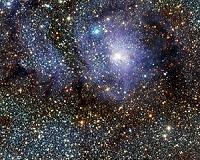 VISTA Stares Deeply Into The Blue Lagoon
Paris, France (SPX) Jan 06, 2011 This new infrared image of the Lagoon Nebula was captured as part of a five-year study of the Milky Way using ESO's VISTA telescope at the Paranal Observatory in Chile. This is a small piece of a much larger image of the region surrounding the nebula, which is, in turn, only one part of a huge survey. Astronomers are currently using ESO's Visible and Infrared Survey Telescope for Astronomy ... read more |
|
|
| The content herein, unless otherwise known to be public domain, are Copyright 1995-2010 - SpaceDaily. AFP and UPI Wire Stories are copyright Agence France-Presse and United Press International. ESA Portal Reports are copyright European Space Agency. All NASA sourced material is public domain. Additional copyrights may apply in whole or part to other bona fide parties. Advertising does not imply endorsement,agreement or approval of any opinions, statements or information provided by SpaceDaily on any Web page published or hosted by SpaceDaily. Privacy Statement |


 del.icio.us
 Digg
Digg Reddit
 YahooMyWeb
 Google
 Facebook


