
 |
 |
 |
 |
 |
 |
 |
 |
 |

 |

Washington DC (SPX) May 13, 2011 In a step toward taking the most advanced atomic clocks on the road, physicists at the National Institute of Standards and Technology (NIST) have designed and demonstrated a super-stable laser operating in a cramped, vibrating location-a minivan. The experiment shows how advanced lasers can be made both stable and transportable enough for field use in geodesy, hydrology, improved radar and space-based tests of fundamental physics. The drive tests, limited to a short excursion of five meters across the grass at the NIST Boulder, Colo., campus, are described in Optics Express. Scientists evaluated the infrared fiber laser's performance with the vehicle stationary, with the motor alternately off and idling, and moving over uneven ground at speeds of less than 1 meter per second (i.e., 3.6 km/hr). The laser frequency remained stable enough with the car parked-the most likely situation in the field-to be used in some applications now, says David Leibrandt, a NIST post-doctoral researcher. "Our group has been building and using ultra-stable lasers for more than 10 years, but they're large and delicate," Leibrandt explains. "The ones we use for our optical atomic clocks occupy a small room and have to be very carefully isolated from seismic and acoustic vibrations. This paper presents a new design that is less sensitive to vibrations and could be made much smaller." NIST scientists stabilized the test laser's frequency using a common technique-locking it to the extremely consistent length of an optical glass cavity. This sphere, about the size of a small orange, hangs in a customized mount with just the right stiffness. The scientists also designed a system to correct the laser frequency when the vehicle moves. Six accelerometers surrounding the cavity measure its linear and rotational acceleration. The accelerometers' signals are routed to a programmable computer chip that predicts and corrects the laser frequency in less than 100 microseconds. The new laser will make it easier to use advanced atomic clocks for geodesy (measurements of the Earth), an application envisioned by the same NIST research group. The laser also might be used on moving platforms, perhaps in space-based physics experiments or on Earth generating low-noise signals for radar. Study results indicate the laser is roughly 10 times more resistant to undesirable effects from vibration or acceleration than the best radio frequency crystal oscillators. Improved mechanical design and higher-bandwidth accelerometers could make the laser even more stable in the future, the researchers say. The research is supported by the Office of Naval Research, Air Force Office of Scientific Research, and Defense Advanced Research Projects Agency.
Share This Article With Planet Earth
Related Links National Institute of Standards and Technology (NIST) Space Technology News - Applications and Research

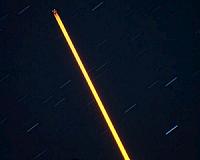 Researchers Find More Efficient Way To Steer Laser Beams
Raleigh NC (SPX) May 03, 2011 For many practical applications involving lasers, it's important to be able to control the direction of the laser beams. Just ask Han Solo, or the captain of the Death Star. Researchers from North Carolina State University have come up with a very energy-efficient way of steering laser beams that is precise and relatively inexpensive. "In many cases, it is much easier to redirect a laser b ... read more |
|
|
| The content herein, unless otherwise known to be public domain, are Copyright 1995-2010 - SpaceDaily. AFP and UPI Wire Stories are copyright Agence France-Presse and United Press International. ESA Portal Reports are copyright European Space Agency. All NASA sourced material is public domain. Additional copyrights may apply in whole or part to other bona fide parties. Advertising does not imply endorsement,agreement or approval of any opinions, statements or information provided by SpaceDaily on any Web page published or hosted by SpaceDaily. Privacy Statement |


 del.icio.us
 Digg
Digg Reddit
 YahooMyWeb
 Google
 Facebook


