
 |
 |
 |
 |
 |
 |
 |
 |
 |

 |

Corvallis OR (SPX) Sep 23, 2010 Researchers at Oregon State University have reported the successful loading of biological molecules onto "nanosprings" - a type of nanostructure that has gained significant interest in recent years for its ability to maximize surface area in microreactors. The findings, announced in the journal Biotechnology Progress, may open the door to important new nanotech applications in production of pharmaceuticals, biological sensors, biomedicine or other areas. "Nanosprings are a fairly new concept in nanotechnology because they create a lot of surface area at the same time they allow easy movement of fluids," said Christine Kelly, an associate professor in the School of Chemical, Biological and Environmental Engineering at OSU. "They're a little like a miniature version of an old-fashioned, curled-up phone cord," Kelly said. "They make a great support on which to place reactive catalysts, and there are a variety of potential applications." The OSU researchers found a way to attach enzymes to silicon dioxide nanosprings in a way that they will function as a biological catalyst to facilitate other chemical reactions. They might be used, for instance, to create a biochemical sensor that can react to a toxin far more quickly than other approaches. "The ability to attach biomolecules on these nanosprings, in an efficient and environmentally friendly way, could be important for a variety of sensors, microreactors and other manufacturing applications," said Karl Schilke, an OSU graduate student in chemical engineering and principal investigator on the study. The work was done in collaboration with the University of Idaho Department of Physics and GoNano Technologies of Moscow, Idaho, a commercial producer of nanosprings. Nanosprings are being explored for such uses as hydrogen storage, carbon cycling and lab-on-chip electronic devices. The research was also facilitated by the Microproducts Breakthrough Institute, a collaboration of OSU and the Pacific Northwest National Laboratory. "An increasingly important aspect of microreactor and biosensor technology is the development of supports that can be easily coated with enzymes, antibodies, or other biomolecules," the researchers wrote in their report. "These requirements are neatly met by nanosprings, structures that can be grown by a chemical vapor deposition process on a wide variety of surfaces," they said. "This study represents the first published application of nanosprings as a novel and highly efficient carrier for immobilized enzymes in microreactors."
Share This Article With Planet Earth
Related Links Oregon State University Nano Technology News From SpaceMart.com Computer Chip Architecture, Technology and Manufacture

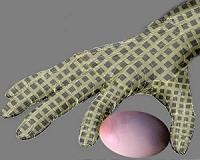 Engineers Make Artificial Skin Out Of Nanowires
Berkeley CA (SPX) Sep 13, 2010 Engineers at the University of California, Berkeley, have developed a pressure-sensitive electronic material from semiconductor nanowires that could one day give new meaning to the term "thin-skinned." "The idea is to have a material that functions like the human skin, which means incorporating the ability to feel and touch objects," said Ali Javey, associate professor of electrical engine ... read more |
|
|
| The content herein, unless otherwise known to be public domain, are Copyright 1995-2010 - SpaceDaily. AFP and UPI Wire Stories are copyright Agence France-Presse and United Press International. ESA Portal Reports are copyright European Space Agency. All NASA sourced material is public domain. Additional copyrights may apply in whole or part to other bona fide parties. Advertising does not imply endorsement,agreement or approval of any opinions, statements or information provided by SpaceDaily on any Web page published or hosted by SpaceDaily. Privacy Statement |


 del.icio.us
 Digg
Digg Reddit
 YahooMyWeb
 Google
 Facebook


