|
 |
 |
 |
 |
 |
 |
 |

| . |  |
. |

|
|
. |

 by Staff Writers Amsterdam, Holland (SPX) Sep 15, 2011
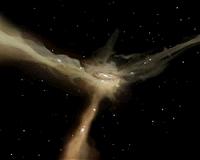
Amsterdam astronomers have discovered a neutron star that confounds existing models for thermonuclear explosions in such extreme objects. In the case of the accreting pulsar IGR J17480-2446, it seems to be a strong magnetic field that causes some parts of the star to burn more brightly than the rest. The results of the study, by Yuri Cavecchi et al. (2011), are to be published in the journal Astrophysical Journal Letters. The neutron star concerned is part of the X-ray binary IGR J17480-2446 (hereafter J17480). X-ray binaries consist of a neutron star and a companion star in orbit around each other. Neutron stars, which are about 1.5 times as massive as the Sun, with a diameter of about 25 km, have a strong gravitational field that can pull gas from the companion star. This gas can build up on the neutron star surface and explode in a fast, high-energy thermonuclear reaction. Normally, the entire surface of the star explodes uniformly. However, in about 10 percent of cases, some parts of the star become much brighter than the rest. Why this occurs is not understood. In recent years a number of theoretical models have been developed to explain this phenomenon. According to one model, the rapid rotation of the neutron star prevents the burning material from spreading, just as the rotation of the Earth contributes to the formation of hurricanes via the Coriolis force. Another idea is that the explosion generates global-scale waves in the surface 'ocean' layers of the star. The ocean on one side of the star cools and dims as it rises up, while the other stays warmer and brighter. The new study of J17480 excludes both of these models. Like other stars, J17480 develops unusually bright surface patches during thermonuclear explosions. However the star rotates much more slowly than other neutron stars that exhibit this behavior - only 10 times per second (the next slowest rotates 245 times per second). At this speed, the Coriolis force is not strong enough to affect the flame front, preventing the formation of thermonuclear hurricanes. The development of large-scale ocean waves can also be ruled out. Instead, the astronomers think that the magnetic field of the star might explain the uneven burning. The exploding gas expands, moving upwards and outwards. This churns up the magnetic field, which acts like an elastic band to prevent the burning bubble from spreading any further. "More theoretical work is needed to confirm this, but in the case of J17480 it is a very plausible explanation for our observations", says lead author Yuri Cavecchi (University of Amsterdam, the Netherlands). Co-author Anna Watts (University of Amsterdam) stressed that their new model may not necessarily explain non-uniform burning for all stars. "The new mechanism may only work in stars like this one, with magnetic fields that are strong enough to stop the flame front from spreading. For other stars with this odd burning behavior, the old models might still apply." Related Links University of Amsterdam, the Netherlands Stellar Chemistry, The Universe And All Within It
|
. |
|
| The content herein, unless otherwise known to be public domain, are Copyright 1995-2011 - Space Media Network. AFP and UPI Wire Stories are copyright Agence France-Presse and United Press International. ESA Portal Reports are copyright European Space Agency. All NASA sourced material is public domain. Additional copyrights may apply in whole or part to other bona fide parties. Advertising does not imply endorsement,agreement or approval of any opinions, statements or information provided by Space Media Network on any Web page published or hosted by Space Media Network. Privacy Statement |

 del.icio.us
 Digg
Digg Reddit
 Google