
 |
 |
 |
 |
 |
 |
 |
 |
 |

 |

Lausanne, Switzerland (SPX) Feb 01, 2011 Smaller and more energy-efficient electronic chips could be made using molybdenite. In an article appearing online January 30 in the journal Nature Nanotechnology, EPFL's Laboratory of Nanoscale Electronics and Structures (LANES) publishes a study showing that this material has distinct advantages over traditional silicon or graphene for use in electronics applications. A discovery made at EPFL could play an important role in electronics, allowing us to make transistors that are smaller and more energy efficient. Research carried out in the Laboratory of Nanoscale Electronics and Structures (LANES) has revealed that molybdenite, or MoS2, is a very effective semiconductor. This mineral, which is abundant in nature, is often used as an element in steel alloys or as an additive in lubricants. But it had not yet been extensively studied for use in electronics.
100,000 times less energy He compares its advantages with two other materials: silicon, currently the primary component used in electronic and computer chips, and graphene, whose discovery in 2004 earned University of Manchester physicists Andre Geim and Konstantin Novoselov the 2010 Nobel Prize in Physics. One of molybdenite's advantages is that it is less voluminous than silicon, which is a three-dimensional material. "In a 0.65-nanometer-thick sheet of MoS2, the electrons can move around as easily as in a 2-nanometer-thick sheet of silicon," explains Kis. "But it's not currently possible to fabricate a sheet of silicon as thin as a monolayer sheet of MoS2." Another advantage of molybdenite is that it can be used to make transistors that consume 100,000 times less energy in standby state than traditional silicon transistors. A semi-conductor with a "gap" must be used to turn a transistor on and off, and molybdenite's 1.8 electron-volt gap is ideal for this purpose.
Better than graphene The existence of this gap in molybdenite also gives it an advantage over graphene. Considered today by many scientists as the electronics material of the future, the "semi-metal" graphene doesn't have a gap, and it is very difficult to artificially reproduce one in the material.
Share This Article With Planet Earth
Related Links Ecole Polytechnique Federale de Lausanne Powering The World in the 21st Century at Energy-Daily.com

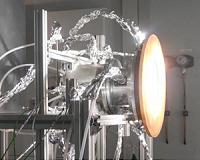 New Reactor Paves The Way For Efficiently Producing Fuel From Sunlight
Pasadena CA (SPX) Jan 21, 2011 Using a common metal most famously found in self-cleaning ovens, Sossina Haile hopes to change our energy future. The metal is cerium oxide-or ceria-and it is the centerpiece of a promising new technology developed by Haile and her colleagues that concentrates solar energy and uses it to efficiently convert carbon dioxide and water into fuels. Solar energy has long been touted as the solut ... read more |
|
|
| The content herein, unless otherwise known to be public domain, are Copyright 1995-2010 - SpaceDaily. AFP and UPI Wire Stories are copyright Agence France-Presse and United Press International. ESA Portal Reports are copyright European Space Agency. All NASA sourced material is public domain. Additional copyrights may apply in whole or part to other bona fide parties. Advertising does not imply endorsement,agreement or approval of any opinions, statements or information provided by SpaceDaily on any Web page published or hosted by SpaceDaily. Privacy Statement |


 del.icio.us
 Digg
Digg Reddit
 YahooMyWeb
 Google
 Facebook


