
 |
 |
 |
 |
 |
 |
 |
 |
 |

 |

Tucson (UPI) Oct 18, 2010 Astronomers in Chile say they've obtained images of a planet in a much closer orbit around its parent star than any other extrasolar planet previously found. The discover was made possible by technology developed at the University of Arizona that blocks out certain parts of a star's light, allowing planets to be spotted from signals previously drowned out by the star's glare, ScienceDaily.com reported Sunday. Installed on the European Southern Observatory's Very Large Telescope in Chile is a small piece of glass with a highly complex pattern inscribed into its surface. Called an Apodizing Phase Plate, the device blocks out the starlight in a very defined way, its developers say. "This technique opens new doors in planet discovery," said Phil Hinz, director of the UA's Center for Astronomical Adaptive Optics at Steward Observatory. "Until now, we only were able to look at the outer planets in a solar system. Now we can see planets on orbits much closer to their parent star. "The technique we developed allows us to search for lower-mass gas giants about the size of Jupiter, which are more representative of what is out there,. "For the first time, we can search around bright, nearby stars such as Alpha Centauri, to see if they have gas giants."
Share This Article With Planet Earth
Related Links Lands Beyond Beyond - extra solar planets - news and science Life Beyond Earth

 How To Weigh A Star Using A Moon
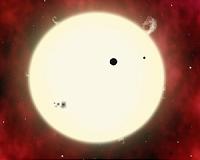
Boston MA (SPX) Oct 18, 2010 Boston MA (SPX) Oct 18, 2010 How do astronomers weigh a star that's trillions of miles away and way too big to fit on a bathroom scale? In most cases they can't, although they can get a best estimate using computer models of stellar structure. New work by astrophysicist David Kipping says that in special cases, we can weigh a star directly. If the star has a planet, and that planet has a ... read more |
|
|
| The content herein, unless otherwise known to be public domain, are Copyright 1995-2010 - SpaceDaily. AFP and UPI Wire Stories are copyright Agence France-Presse and United Press International. ESA Portal Reports are copyright European Space Agency. All NASA sourced material is public domain. Additional copyrights may apply in whole or part to other bona fide parties. Advertising does not imply endorsement,agreement or approval of any opinions, statements or information provided by SpaceDaily on any Web page published or hosted by SpaceDaily. Privacy Statement |


 del.icio.us
 Digg
Digg Reddit
 YahooMyWeb
 Google
 Facebook


