
 |
 |
 |
 |
 |
 |
 |
 |
 |

 |

Flagstaff AZ (SPX) Oct 06, 2010 A team of scientists at Northern Arizona University, Missouri State University, and Flagstaff's Lowell Observatory has revealed that the frozen surface of Eris, the largest-known dwarf planet orbiting the Sun, is predominantly covered in nitrogen ice, similar to the surface of Pluto. Stephen Tegler, NAU professor of physics and astronomy and lead author of "Methane and Nitrogen Abundances on Eris and Pluto," presented the team's findings Oct. 5, at the 42nd annual meeting of the American Astronomical Society's Division for Planetary Sciences in Pasadena, Calif. The paper also was submitted for publication to the Astrophysical Journal. Tegler's results integrated two years of work conducted in NAU's new ice lab, in addition to astronomical observations of Eris from the Multiple Mirror Telescope Observatory from Mount Hopkins, Ariz., and of Pluto from Steward Observatory from Kitt Peak, Ariz. "There are only a handful of such labs doing this kind of work in the world," Tegler said. "By studying surfaces of icy dwarf planets, we hope to get a better understanding of the processes that affect their surfaces." NAU's ice lab grew optically clear ice samples of methane, nitrogen, argon, methane-nitrogen mixtures, and methane-argon mixtures in a vacuum chamber at temperatures as low as minus 390 degrees Fahrenheit to simulate the planets' cold surfaces. Light passed through the samples revealed the "chemical fingerprints" of molecules and atoms, which were compared to telescopic observations of sunlight reflected from the surfaces of Eris and Pluto. "By combining the astronomical data and laboratory data, we found about 90 percent of Eris's icy surface is made up of nitrogen ice and about 10 percent is made up of methane ice, which is not all that different from Pluto," said David Cornelison, coauthor and physicist at Missouri State University. Discovered in 2003 and named after the goddess of warfare and strife, Eris hit the astronomical map with the largest diameter of any known dwarf planet, consequently unseating its smaller neighbor Pluto from "official" planet to dwarf planet status. Since then, Eris has held the attention of astronomers and physicists as they strive to gain a better understanding of the farthest reaches of the solar system. The recent findings will directly enhance NASA's New Horizons spacecraft mission, currently scheduled to fly by Pluto in 2015, lending greater value to the continued research of Eris and Pluto. William Grundy, an astronomer at Lowell Observatory, is a member of NASA's New Horizons Team and contributing author of the paper. "By measuring and then comparing and contrasting the properties of Eris and Pluto, we can better understand how planets in the outer solar system formed and then evolved over the last 4.5 billion years," Grundy said.
Share This Article With Planet Earth
Related Links Northern Arizona University The million outer planets of a star called Sol

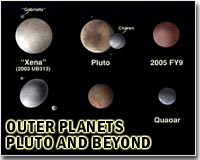 Uranus may have been cosmic 'pinball'
Paris (UPI) Sep 17, 2010 Jupiter and Saturn may have played a game of cosmic "pinball" with the planet Uranus before finally tossing it into its present orbit, French researchers say. Computer simulations have shown that Jupiter and Saturn moved out of their orbits in the early history of the solar system, scattering other nearby orbiting objects, NewScientist.com reports. Alessandro Morbidelli of the Co ... read more |
|
|
| The content herein, unless otherwise known to be public domain, are Copyright 1995-2010 - SpaceDaily. AFP and UPI Wire Stories are copyright Agence France-Presse and United Press International. ESA Portal Reports are copyright European Space Agency. All NASA sourced material is public domain. Additional copyrights may apply in whole or part to other bona fide parties. Advertising does not imply endorsement,agreement or approval of any opinions, statements or information provided by SpaceDaily on any Web page published or hosted by SpaceDaily. Privacy Statement |


 del.icio.us
 Digg
Digg Reddit
 YahooMyWeb
 Google
 Facebook


