
 |
 |
 |
 |
 |
 |
 |
 |
 |

 |
Observing Jupiter To Understand Earth
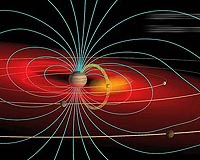
Paris, France (ESA) Dec 08, 2008 Magnetic substorms on Earth disrupt orbiting satellites, including telecommunication satellites and global positioning systems. This mysterious phenomenon has been studied with ESA's Cluster satellites, comparing it with magnetic substorms on the giant planet Jupiter for a better understanding. How the magnetosphere gets stormy planets such as Mercury, Earth or Jupiter that have their own magnetic field are protected by the magnetic bubble that it generates. During a magnetic substorm on Earth, particles located tens of thousands kilometres on the nightside are energised and hurled earthward within a few minutes. This creates colourful aurorae and excites the near-Earth environment, disrupting communications between Earth and orbiting satellites and affecting global positioning systems. Despite decades of space-based research, several aspects of this phenomenon remain unknown. One such unknown aspect is the mechanism that triggers these storms: it is not clear whether the storms are caused by processes internal to the magnetosphere or by other external processes (solar origin). Dr Elena Kronberg and colleagues at the Max Planck institute for Solar System Research, Germany, decided to look away from Earth, to other planets, to see if they could learn something new.
The Jupiter connection This duration is longer partly because of Jupiter's stronger magnetic field and larger magnetosphere. The jovian magnetic field is so large that Jupiter's magnetosphere envelopes the planet's galilean moons: Io, Europa, Ganymede and Calisto. After detailed analyses of data from several missions, Dr Kronberg said, "We've found that at Earth and Jupiter, the magnetic field undergoes the same three steps during a substorm: growth, expansion and recovery." Kronberg and colleagues studied data from NASA's Galileo spacecraft. In 2007, they reported that periodic substorms at Jupiter were connected to the constant release of matter by the jovian satellite Io, which lies inside the jovian magnetosphere. This release of matter forms part of the mechanism that triggers the substorm. This means that the driver of this phenomenon is internal to the jovian magnetosphere. Extrapolating this mechanism to the terrestrial magnetosphere, Kronberg and colleagues propose that under certain conditions, periodic magnetospheric substorms at Earth may be driven internally by plasma eroded from the plasmasphere, a region of Earth's magnetosphere. This feeds the magnetosphere, providing the matter required to trigger a substorm. "With Cluster, we've gained a better understanding of the processes taking place inside Earth's magnetosphere; this has enhanced our understanding of how our Solar System works. And now we're delighted to learn more from gigantic Jupiter itself." remarked Philippe Escoubet, ESA's Cluster Project Scientist. Share This Article With Planet Earth
Related Links Cluster Overview Jupiter and its Moons Explore The Ring World of Saturn and her moons The million outer planets of a star called Sol News Flash at Mercury
 Jupiter Has Large, Rocky Core Surrounded By Layer Of Ice
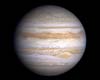 Berkeley CA (SPX) Nov 26, 2008
Jupiter has a rocky core that is more than twice as large as previously thought, according to computer calculations by a University of California, Berkeley, geophysicist who simulated conditions inside the planet on the scale of individual hydrogen and helium atoms. The results were published in Astrophysical Journal Letters. |
|
|

| The content herein, unless otherwise known to be public domain, are Copyright 1995-2007 - SpaceDaily.AFP and UPI Wire Stories are copyright Agence France-Presse and United Press International. ESA Portal Reports are copyright European Space Agency. All NASA sourced material is public domain. Additional copyrights may apply in whole or part to other bona fide parties. Advertising does not imply endorsement,agreement or approval of any opinions, statements or information provided by SpaceDaily on any Web page published or hosted by SpaceDaily. Privacy Statement |
 del.icio.us
 Digg
Digg Reddit
 YahooMyWeb
 Google
 Facebook