
 |
 |
 |
 |
 |
 |
 |
 |
 |

 |

Pasadena CA (SPX) Oct 22, 2010 Opportunity crossed the 24-kilometer (15-mile) odometry mark on her way to Endeavour crater. The rover ended last week with the data backlog which limited activities over the weekend. On Sol 2390 (Oct. 14, 2010), the alpha particle X-ray spectrometer (APXS) was sequenced to collect an atmospheric argon measurement along with light remote sensing. Not until Sol 2393 (Oct. 17, 2010), were onboard data volumes improved so a drive could be sequenced. On that sol, Opportunity drove over 100 meters (328 feet), crossing the 24-kilometer (15 mile) odometry mark. The rover drove again on Sol 2395 (Oct. 19, 2010), again reaching over 100 meters (328 miles). Even though the Miniature Thermal Emission Spectrometer (Mini-TES) instrument is still under investigation, the Mini-TES elevation mirror continues to be opened to the environment at regular intervals in the chance of catching a wind-induced cleaning event. As of Sol 2395 (Oct. 19, 2010), solar array energy production was 627 watt-hours with a slightly elevated atmospheric opacity (Tau) of 0.639 and a solar array dust factor of 0.7015. Total odometry is 24,192.63 meters (24.19 kilometers, or 15.03 miles).
related report The findings, published in a recent issue of the journal Science, reveal how carbon dioxide isotopes have reacted to volcanic activity, water and weathering - thus forming a more complete picture of the current Martian atmosphere. The NASA mission in which this work was accomplished was the Phoenix Lander, an unmanned spacecraft deployed to Mars in 2008. UT Dallas Physics Professor John Hoffman, a member of the William B. Hanson Center for Space Sciences, designed the mass spectrometer through which soil samples collected at the surface of Mars were analyzed. Samples of atmospheric gasses were drawn into the instrument during several Martian days, called "sols," and analyzed to determine the type of gases that comprise the atmosphere. "The dominant gas is carbon dioxide," Hoffman said. "We examined these carbon dioxide molecules and measured the ratio of the light to heavy atoms of carbon and oxygen." Different mass atoms of an element are called isotopes. By contrasting these isotopes, Hoffman and other researchers could see how the gases were affected by geologic processes on Mars. Previous samples from the Martian atmosphere were analyzed three decades ago during NASA's Viking program. The precision of those measurements was limited by the technology available at the time. "The accuracy of the current measurements far surpasses the previous information we had," Hoffman said. "Obviously, these geologic and atmospheric changes are slow processes, but we now have a better idea of the earlier planetary atmosphere." Scientists have also studied material from Martian meteorites that have landed on Earth. These data have helped fill in the time scale for the evolution of the atmosphere on Mars. "These findings are exciting because they show how the atmosphere of Mars evolved and we can contrast that to our own history here on Earth," Hoffman added. "We have a more complete understanding of our neighboring planet." The research was funded by NASA as part of the Mars Scout Program. The work was conducted in collaboration with researchers at the University of Arizona.
Share This Article With Planet Earth
Related Links Mars Exploration Rovers Mars News and Information at MarsDaily.com Lunar Dreams and more

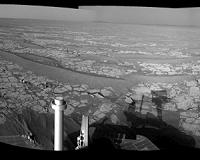 Opportunity's Eastward View After Sol 2382 Drive
Pasadena CA (JPL) Oct 22, 2010 This mosaic of images from the navigation camera on NASA's Mars Exploration Rover Opportunity shows a 90-degree view centered toward the east following a 93.3-meter (306-foot) drive east-northeastward during the 2,382nd Martian day, or sol, of Opportunity's mission on Mars (Oct. 6, 2010). The camera took the component images for this mosaic on Sol 2382 after the drive. The terrain in ... read more |
|
|
| The content herein, unless otherwise known to be public domain, are Copyright 1995-2010 - SpaceDaily. AFP and UPI Wire Stories are copyright Agence France-Presse and United Press International. ESA Portal Reports are copyright European Space Agency. All NASA sourced material is public domain. Additional copyrights may apply in whole or part to other bona fide parties. Advertising does not imply endorsement,agreement or approval of any opinions, statements or information provided by SpaceDaily on any Web page published or hosted by SpaceDaily. Privacy Statement |


 del.icio.us
 Digg
Digg Reddit
 YahooMyWeb
 Google
 Facebook


