
 |
 |
 |
 |
 |
 |
 |
 |
 |

 |

Toulon, France (SPX) Nov 28, 2010 OPTIS reports that the China Academy of Space Technology in Beijing has chosen OPTIS's OptisWorks software for stray light analysis to optimize the optical performance. The China Academy of Space Technology, the leading space agency in China, is responsible for the coordination of the national Chinese Space Programme. They participated in the development of the As optical systems become more and more complicated the phenomenon known as "stray light" poses increasingly complex problems for the designer. Stray light within any imaging system, such as a camera, telescope or night vision equipment, significantly affects the optical performance, reducing the accuracy, fidelity and eventually jeopardising the reliability of the image. These inefficiencies have serious implications for defense and safety applications; an observer's view through an optical system affected by stray light could be of such bad quality that objects supposedly in the scene may not be recognised and, conversely, those objects outside of the scene may appear as ghost images. Clearly the ability to distinguish and correct the true signal compared to the internal "noise" generated provides the only solution to a 100% reliable system and OPTIS R and D, backed by OPTIS local team in Shanghai, have worked closely with the engineers at China Academy of Space Technology to optimise the detection of these internal discrepancies. China Academy of Space Technology selected OPTIS' OptisWorks solution because of its unique integration into the SolidWorks CAD package, offering designers the chance to fully interact with their model and visualize the influence of each component on the stray light. CAD integration also enabled them to optimize optical and mechanical aspects concurrently and try out multiple iterations to find the right design solution. "The OPTIS stray light analysis tool enables our engineers to design more reliable and accurate space imaging equipment. Thanks to OPTIS they have minimised noise from reflections and optimised the signal at the viewpoint," said Dr. Wen Ping Lei of CAST. "OptisWorks' real bonus was being directly integrated in our existing CAD software. That gives us incredible power to detect, and actually visualise on the screen, how each component contributes to stray light, so we know which parts to modify right from the start of the design process. We are delighted to be working with OPTIS and to have jointly developed the stray light analysis function." Pete Moorhouse, VP Sales at OPTIS, commented, "Our relationship with CAST once again proves that innovation is key to success. Our ability to quickly transform customer's requirements into production ready solutions helps consolidate our leading position and provides engineers with unique applications to solve complex problems." OPTIS' simulation software suite is the most sophisticated and comprehensive optical solution available for designing any product that manages or interacts with light. The software provides highly realistic simulation of light sources, materials, and environments, enabling designers to optimize the optical performances and appearance of any system without costly experimental prototyping. OPTIS software is unique in its ability to simulate human perception and lit appearance, the ability to provide the exact color and appearance of any object taking into account measured material properties and its seamless integration within major CAD platforms.
Share This Article With Planet Earth
Related Links CAST Optis World The Chinese Space Program - News, Policy and Technology China News from SinoDaily.com

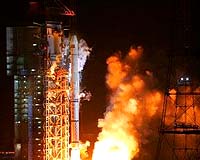 China puts satellite in orbit
Xichang, China (UPI) Nov 26, 2010 China launched a Long March 3A carrier rocket Thursday, putting a communication satellite into orbit around the Earth, officials said. The rocket was launched at 12:09 a.m. from the Xichang Satellite Launch Center in Sichuan province, Xinhua reported. The "Zhongxing-20A" satellite is expected to improve China's radio and television broadcasts, officials at the launch center said ... read more |
|
|
| The content herein, unless otherwise known to be public domain, are Copyright 1995-2010 - SpaceDaily. AFP and UPI Wire Stories are copyright Agence France-Presse and United Press International. ESA Portal Reports are copyright European Space Agency. All NASA sourced material is public domain. Additional copyrights may apply in whole or part to other bona fide parties. Advertising does not imply endorsement,agreement or approval of any opinions, statements or information provided by SpaceDaily on any Web page published or hosted by SpaceDaily. Privacy Statement |


 del.icio.us
 Digg
Digg Reddit
 YahooMyWeb
 Google
 Facebook


