
 |
 |
 |
 |
 |
 |
 |
 |
 |

 |

Geneva (AFP) April 5, 2011 Depletion of the ozone layer over the Arctic has reached record levels, and Nordic countries will have to watch for higher than normal ultraviolet radiation in coming weeks, the UN weather agency said Tuesday. The Arctic ozone layer suffered a loss of about 40 percent from the beginning of winter to late March, up from the previous record of about 30 percent over the entire winter, according to the World Meteorological Organisation. "Depletion of the ozone layer -- the shield that protects life on Earth from harmful levels of ultraviolet rays -- has reached an unprecedented level over the Arctic this spring because of the continuing presence of ozone-depleting substances in the atmosphere and a very cold winter in the stratosphere," the WMO said in a statement. With the ozone deficient region shifting away in late March from the pole to cover Greenland and Scandinavia, these Nordic regions would have to watch for higher than normal ultraviolet radiation in coming weeks. "As the solar elevation at noon increases over the next weeks, regions affected by the ozone depletion will experience higher than normal UV radiation," said the WMO. "The public is recommended to stay informed through national UV forecasts," it said. The stratosphere is the second major layer of the atmosphere, and about 90 percent of the ozone in the atmosphere is found here. Stratospheric ozone provides a natural protective filter against harmful ultra-violet rays from the sun, which can cause sunburn, cataracts and skin cancer and damage vegetation. Its depletion is caused by extreme cold temperatures at high altitude and a particular type of pollution, from chemicals often used in refrigeration, some plastic foams, or aerosol sprays, which have accumulated in the atmosphere. Most of the chemicals, chloroflurocarbons (CFCs), are being phased out under the 1987 Montreal Protocol, but they linger in the atmosphere for many years. Thanks to the accord, however, the ozone layer outside the polar regions is projected to recover to its pre-1980 levels at around 2030 to 2040. Over the Antarctic, the ozone layer is expected to recover at around 2045 to 2060 while over the Arctic, this should happen one or two decades earlier. "The degree of ozone loss experienced in any particular winter depends on the meteorological conditions," noted Michel Jarraud, WMO secretary-general. "The Arctic stratosphere continues to be vulnerable to ozone destruction caused by ozone-depleting substances linked to human activities," he said. "The 2011 ozone loss shows that we have to remain vigilant and keep a close eye on the situation in the Arctic in the coming years," added the UN weather chief.
Share This Article With Planet Earth
Related Links All about the Ozone Layer

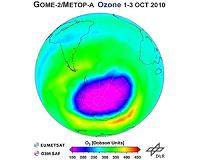 DLR Researchers Contribute New Insights On Changes In The Ozone Layer
Berlin, Germany (SPX) Feb 28, 2011 German Aerospace Center researchers have been instrumental in the preparation of a report on the changes in the Ozone Layer for the World Meteorological Organization (WMO). The report was published online by the Geneva-based WMO in January. Recent estimates suggest that, by the middle of the 21st century, the thickness of Ozone Layer will be the same as in the early 1980s. "This positive d ... read more |
|
|
| The content herein, unless otherwise known to be public domain, are Copyright 1995-2010 - SpaceDaily. AFP and UPI Wire Stories are copyright Agence France-Presse and United Press International. ESA Portal Reports are copyright European Space Agency. All NASA sourced material is public domain. Additional copyrights may apply in whole or part to other bona fide parties. Advertising does not imply endorsement,agreement or approval of any opinions, statements or information provided by SpaceDaily on any Web page published or hosted by SpaceDaily. Privacy Statement |


 del.icio.us
 Digg
Digg Reddit
 YahooMyWeb
 Google
 Facebook


