
 |
 |
 |
 |
 |
 |
 |
 |
 |

 |

Madrid, Spain (SPX) Jul 28, 2010 "The total impact probability of asteroid '(101955) 1999 RQ36' can be estimated in 0.00092 - approximately one-in-a-thousand chance - but what is most surprising is that over half of this chance (0.00054) corresponds to 2182," explains to SINC Maria Eugenia Sansaturio, co-author of the study and researcher of Universidad de Valladolid (UVA). The research also involved scientists from the University of Pisa (Italy), the Jet Propulsion Laboratory (USA) and INAF-IASF-Rome (Italy). Scientists have estimated and monitored the potential impacts for this asteroid through 2200 by means of two mathematical models (Monte Carlo Method and line of variations sampling). Thus, the so called Virtual Impactors (VIs) have been searched. VIs are sets of statistical uncertainty leading to collisions with the Earth on different dates of the XXII century. Two VIs appear in 2182 with more than half the chance of impact. Asteroid '(101955) 1999 RQ36' is part of the Potentially Hazardous Asteroids (PHA), which have the possibility of hitting the Earth due to the closeness of their orbits, and they may cause damages. This PHA was discovered in 1999 and has around 560 meters in diameter.
The Yarkovsky effect Such disturbance slightly modifies the orbits of the Solar System's small objects because, when rotating, they radiate from one side the radiation they take from the sun through the other side. The research, which has been published in Icarus journal, predicts what could happen in the upcoming years considering this effect. Up to 2060, divergence of the impacting orbits is moderate; between 2060 and 2080 it increases 4 orders of magnitude because the asteroid will approach the Earth in those years; then, it increases again on a slight basis until another approach in 2162, it then decreases, and 2182 is the most likely year for the collision. "The consequence of this complex dynamic is not just the likelihood of a comparatively large impact, but also that a realistic deflection procedure (path deviation) could only be made before the impact in 2080, and more easily, before 2060," stands out Sansaturio. The scientist concludes: "If this object had been discovered after 2080, the deflection would require a technology that is not currently available. Therefore, this example suggests that impact monitoring, which up to date does not cover more than 80 or 100 years, may need to encompass more than one century. Thus, the efforts to deviate this type of objects could be conducted with moderate resources, from a technological and financial point of view."
Share This Article With Planet Earth
Related Links FECYT - Spanish Foundation for Science and Technology Asteroid and Comet Impact Danger To Earth - News and Science

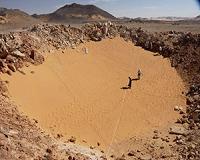 'Pristine' Earth impact crater discovered
Cairo (UPI) Jul 23, 2010 Scientists say a meteoric impact crater found in the remote Egyptian desert may be the best-preserved ever found on Earth. The Kamil crater is pristine, unlike most Earth impact sites that are partially or severely eroded, and maintains much of its structure, including the rays of ejected material thrown from the crater when the space rock hit, SPACE.com reported Thursday. "This ... read more |
|
|
| The content herein, unless otherwise known to be public domain, are Copyright 1995-2010 - SpaceDaily. AFP and UPI Wire Stories are copyright Agence France-Presse and United Press International. ESA Portal Reports are copyright European Space Agency. All NASA sourced material is public domain. Additional copyrights may apply in whole or part to other bona fide parties. Advertising does not imply endorsement,agreement or approval of any opinions, statements or information provided by SpaceDaily on any Web page published or hosted by SpaceDaily. Privacy Statement |


 del.icio.us
 Digg
Digg Reddit
 YahooMyWeb
 Google
 Facebook


