
 |
 |
 |
 |
 |
 |
 |
 |
 |

 |
Prehistoric giant kangaroos killed by man, not climate, study says
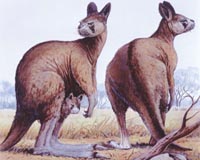
Sydney (AFP) Aug 12, 2008 The chance discovery of the remains of a prehistoric giant kangaroo has cast doubts on the long-held view that climate change drove it and other mega-fauna to extinction, a new study reveals. The research, published this week in the US-based journal Proceedings of the National Academy of Sciences, argues that man likely hunted to death the giant kangaroo and other very large animals on the southern island of Tasmania. The debate centres on the skull of a giant kangaroo found in a cave in the thick rainforest of the rugged northwest of Tasmania in 2000. Scientists dated the find at 41,000 years old, some 2,000 years after humans first began to live in the area. "Up until now, people thought that the Tasmanian mega-fauna had actually gone extinct before people arrived on the island," a member of the British and Australian study, Professor Richard Roberts, told AFP Tuesday. He said that it was likely that hunting killed off Tasmania's mega-fauna -- including the long-muzzled, 120 kilogram (264 pound) giant kangaroo, a rhinoceros-sized wombat and marsupial 'lions' which resembled leopards. Roberts, from the University of Wollongong south of Sydney, said the idea that climate change could account for the death of the animals was disputed by the fact the area had a very stable climate in the critical time period. "Things were very climatically stable in that part of Australia and yet the mega-fauna still managed to go extinct," he said. "So it's down to humans of one sort or another." Roberts said because the large animals were slow breeders, it would not have required an aggressive campaign to see them quickly die out. "A lot of people still have in their minds an axe-wielding, spear-wielding people, bloodthirsty, out there slaughtering all over the place -- it wasn't like that at all," he said. "It was basically just one joey (baby kangaroo) in the pot for Christmas. And that's all you've got to go to do to drive slow-breeding species to extinction." Roberts said the Tasmanian results back up the theory that man was responsible for the death of the mega-fauna on mainland Australia, estimated by some to have occurred shortly after human occupation about 46,000 years ago. The reasons behind the mass extinction of giant animals, which took place around the world towards the end of the last ice age, has been hotly contested with theories ranging from climate change to human and extraterrestrial impacts. The finding of the latest study has already been contested, with Judith Field of the University of Sydney saying the idea that humans killed the giant creatures was "in the realms of speculative fantasy". "Humans cannot even be placed at the scene," she told the Sydney Morning Herald. Community Email This Article Comment On This Article Share This Article With Planet Earth
Related Links Darwin Today At TerraDaily.com
 Baby panda adopted by house cat dies: zoo
 The Hague (AFP) July 18, 2008
A baby panda adopted by a domestic cat at Amsterdam's Artis zoo has died after choking on the milk of its foster mother, the zoo said Friday. |
|
|

| The content herein, unless otherwise known to be public domain, are Copyright 1995-2007 - SpaceDaily.AFP and UPI Wire Stories are copyright Agence France-Presse and United Press International. ESA Portal Reports are copyright European Space Agency. All NASA sourced material is public domain. Additional copyrights may apply in whole or part to other bona fide parties. Advertising does not imply endorsement,agreement or approval of any opinions, statements or information provided by SpaceDaily on any Web page published or hosted by SpaceDaily. Privacy Statement |
 del.icio.us
 Digg
Digg Reddit
 YahooMyWeb
 Google
 Facebook