
 |
 |
 |
 |
 |
 |
 |
 |
 |

 |

Paris, France (SPX) Nov 25, 2010 Grzegorz Pietrzynski introduces this remarkable result: "By using the HARPS instrument on the 3.6-metre telescope at ESO's La Silla Observatory in Chile, along with other telescopes, we have measured the mass of a Cepheid with an accuracy far greater than any earlier estimates. This new result allows us to immediately see which of the two competing theories predicting the masses of Cepheids is correct." Classical Cepheid Variables, usually called just Cepheids, are unstable stars that are larger and much brighter than the Sun. They expand and contract in a regular way, taking anything from a few days to months to complete the cycle. The time taken to brighten and grow fainter again is longer for stars that are more luminous and shorter for the dimmer ones. This remarkably precise relationship makes the study of Cepheids one of the most effective ways to measure the distances to nearby galaxies and from there to map out the scale of the whole Universe. Unfortunately, despite their importance, Cepheids are not fully understood. Predictions of their masses derived from the theory of pulsating stars are 20% less than predictions from the theory of the evolution of stars. This embarrassing discrepancy has been known since the 1960s. To resolve this mystery, astronomers needed to find a double star containing a Cepheid where the orbit happened to be seen edge-on from Earth. In these cases, known as eclipsing binaries, the brightness of the two stars dims as one component passes in front of the other, and again when it passes behind the other star. In such pairs astronomers can determine the masses of the stars to high accuracy. Unfortunately neither Cepheids nor eclipsing binaries are common, so the chance of finding such an unusual pair seemed very low. None are known in the Milky Way. Wolfgang Gieren, another member of the team, takes up the story: "Very recently we actually found the double star system we had hoped for among the stars of the Large Magellanic Cloud. It contains a Cepheid variable star pulsating every 3.8 days. The other star is slightly bigger and cooler, and the two stars orbit each other in 310 days. The true binary nature of the object was immediately confirmed when we observed it with the HARPS spectrograph on La Silla." The observers carefully measured the brightness variations of this rare object, known as OGLE-LMC-CEP0227, as the two stars orbited and passed in front of one another. They also used HARPS and other spectrographs to measure the motions of the stars towards and away from the Earth - both the orbital motion of both stars and the in-and-out motion of the surface of the Cepheid as it swelled and contracted. This very complete and detailed data allowed the observers to determine the orbital motion, sizes and masses of the two stars with very high accuracy - far surpassing what had been done before for a Cepheid. The mass of the Cepheid is now known to about 1% and agrees exactly with predictions from the theory of stellar pulsation. However, the larger mass predicted by stellar evolution theory was shown to be significantly in error. The much-improved mass estimate is only one outcome of this work, and the team hopes to find other examples of these remarkably useful pairs of stars to exploit the method further. They also believe that from such binary systems they will eventually be able to pin down the distance to the Large Magellanic Cloud to 1%, which would mean an extremely important improvement of the cosmic distance scale.
Share This Article With Planet Earth
Related Links ESO Stellar Chemistry, The Universe And All Within It

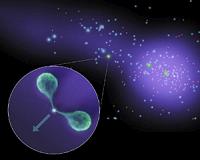 Astronomers Probe 'Sandbar' Between Islands Of Galaxies
Pasadena CA (JPL) Nov 25, 2010 Astronomers have caught sight of an unusual galaxy that has illuminated new details about a celestial "sandbar" connecting two massive islands of galaxies. The research was conducted in part with NASA's Spitzer Space Telescope. These "sandbars," or filaments, are known to span vast distances between galaxy clusters and form a lattice-like structure known as the cosmic web. Though imm ... read more |
|
|
| The content herein, unless otherwise known to be public domain, are Copyright 1995-2010 - SpaceDaily. AFP and UPI Wire Stories are copyright Agence France-Presse and United Press International. ESA Portal Reports are copyright European Space Agency. All NASA sourced material is public domain. Additional copyrights may apply in whole or part to other bona fide parties. Advertising does not imply endorsement,agreement or approval of any opinions, statements or information provided by SpaceDaily on any Web page published or hosted by SpaceDaily. Privacy Statement |


 del.icio.us
 Digg
Digg Reddit
 YahooMyWeb
 Google
 Facebook


