
 |
 |
 |
 |
 |
 |
 |
 |
 |

 |

Rochester NY (SPX) Nov 19, 2010 Scientists have simulated, for the first time, the merger of two black holes of vastly different sizes, with one mass 100 times larger than the other. This extreme mass ratio of 100:1 breaks a barrier in the fields of numerical relativity and gravitational wave astronomy. Until now, the problem of simulating the merger of binary black holes with extreme size differences had remained an unexplored region of black-hole physics. "Nature doesn't collide black holes of equal masses," says Carlos Lousto, associate professor of mathematical sciences at Rochester Institute of Technology and a member of the Center for Computational Relativity and Gravitation. "They have mass ratios of 1:3, 1:10, 1:100 or even 1:1 million. This puts us in a better situation for simulating realistic astrophysical scenarios and for predicting what observers should see and for telling them what to look for. "Leaders in the field believed solving the 100:1 mass ratio problem would take 5 to 10 more years and significant advances in computational power. It was thought to be technically impossible." "These simulations were made possible by advances both in the scaling and performance of relativity computer codes on thousands of processors, and advances in our understanding of how gauge conditions can be modified to self-adapt to the vastly different scales in the problem," adds Yosef Zlochower, assistant professor of mathematical sciences and a member of the center. A paper announcing Lousto and Zlochower's findings was submitted for publication in Physical Review Letters. The only prior simulation describing an extreme merger of black holes focused on a scenario involving a 1:10 mass ratio. Those techniques could not be expanded to a bigger scale, Lousto explained. To handle the larger mass ratios, he and Zlochower developed numerical and analytical techniques based on the moving puncture approach - a breakthrough, created with Manuela Campanelli, director of the Center for Computational Relativity and Gravitation, that led to one of the first simulations of black holes on supercomputers in 2005. The flexible techniques Lousto and Zlochower advanced for this scenario also translate to spinning binary black holes and for cases involving smaller mass ratios. These methods give the scientists ways to explore mass ratio limits and for modeling observational effects. Lousto and Zlochower used resources at the Texas Advanced Computer Center, home to the Ranger supercomputer, to process the massive computations. The computer, which has 70,000 processors, took nearly three months to complete the simulation describing the most extreme-mass-ratio merger of black holes to date. "Their work is pushing the limit of what we can do today," Campanelli says. "Now we have the tools to deal with a new system." Simulations like Lousto and Zlochower's will help observational astronomers detect mergers of black holes with large size differentials using the future Advanced LIGO (Laser Interferometer Gravitational-wave Observatory) and the space probe LISA (Laser Interferometer Space Antenna). Simulations of black-hole mergers provide blueprints or templates for observational scientists attempting to discern signatures of massive collisions. Observing and measuring gravitational waves created when black holes coalesce could confirm a key prediction of Einstein's general theory of relativity.
Share This Article With Planet Earth
Related Links Rochester Institute of Technology Understanding Time and Space

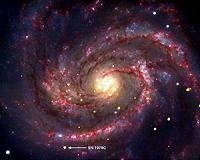 Chandra Finds Youngest Nearby Black Hole
Washington DC (SPX) Nov 16, 2010 Astronomers using NASA's Chandra X-ray Observatory have found evidence of the youngest black hole known to exist in our cosmic neighborhood. The 30-year-old black hole provides a unique opportunity to watch this type of object develop from infancy. The black hole could help scientists better understand how massive stars explode, which ones leave behind black holes or neutron stars, and the ... read more |
|
|
| The content herein, unless otherwise known to be public domain, are Copyright 1995-2010 - SpaceDaily. AFP and UPI Wire Stories are copyright Agence France-Presse and United Press International. ESA Portal Reports are copyright European Space Agency. All NASA sourced material is public domain. Additional copyrights may apply in whole or part to other bona fide parties. Advertising does not imply endorsement,agreement or approval of any opinions, statements or information provided by SpaceDaily on any Web page published or hosted by SpaceDaily. Privacy Statement |


 del.icio.us
 Digg
Digg Reddit
 YahooMyWeb
 Google
 Facebook


