|
 |
 |
 |
 |
 |
 |
 |

| . |  |
. |

|
|
. |

 by Staff Writers West Lafayette, IN (SPX) Dec 21, 2011
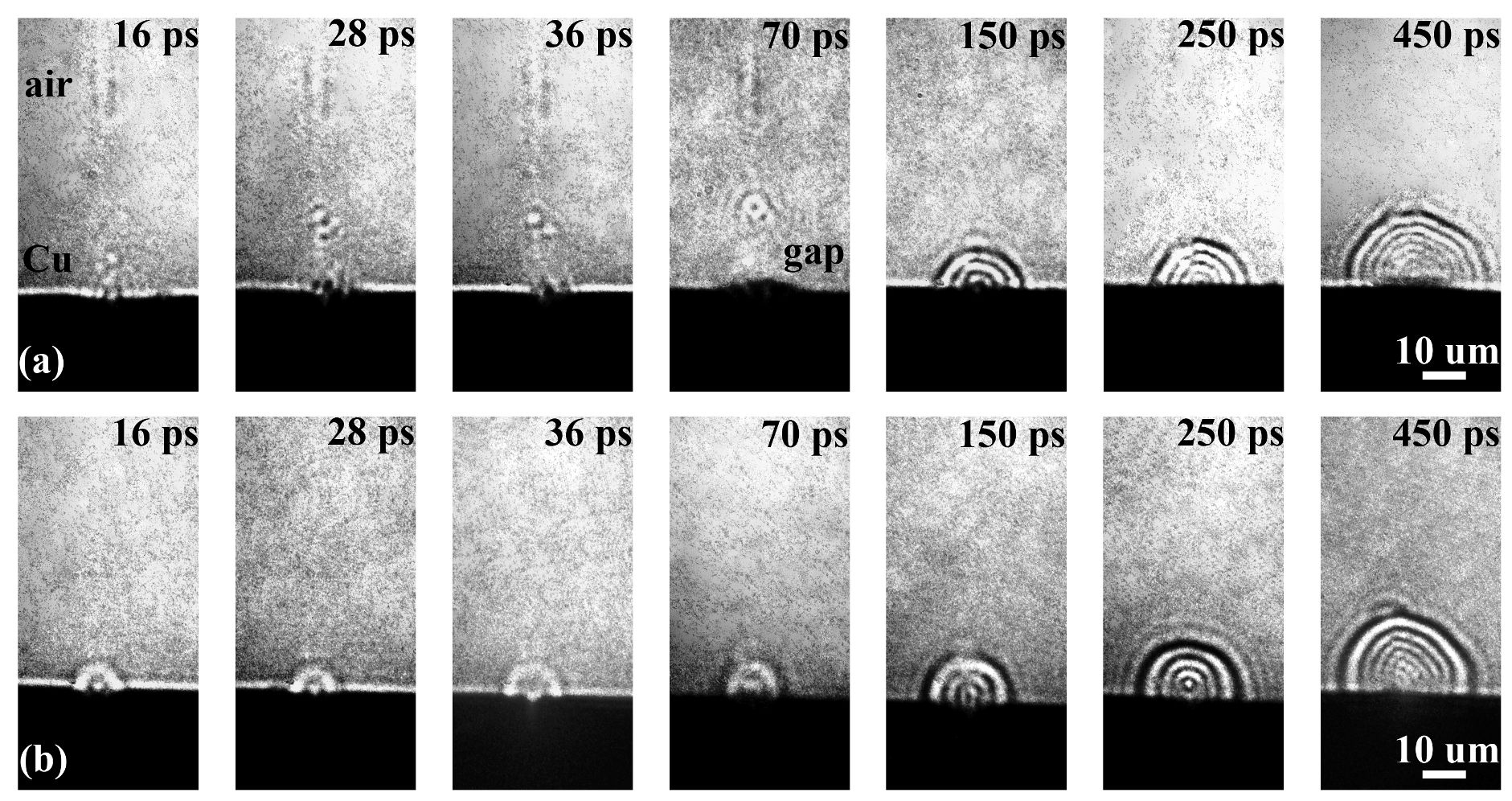
Engineers have discovered details about the behavior of ultrafast laser pulses that may lead to new applications in manufacturing, diagnostics and other research. Ultrafast laser pulses are used to create features and surface textures in metals, ceramics and other materials for applications including the manufacture of solar cells and biosensors. The lasers pulse at durations of 100 femtoseconds, or quadrillionths of a second, and cause electrons to reach temperatures greater than 60,000 degrees Celsius during the pulse duration. The pulses create precise patterns in a process called "cold ablation," which turns material into a plasma of charged particles. Images taken with a high-speed camera show tiny mushroom clouds eerily similar in appearance to those created in a nuclear explosion. The clouds expand outward at speeds of 100 to 1,000 times the speed of sound within less than one nanosecond. However, new findings reveal that an earlier cloud forms immediately before the mushroom cloud, and this early plasma interferes with the laser pulses, hindering performance, said Yung Shin, a professor of mechanical engineering and director of Purdue University's Center for Laser-Based Manufacturing. Finding a way to eliminate the interference caused by the early plasma could open up new applications in manufacturing, materials and chemical processing, machining and advanced sensors to monitor composition, and chemical and atomic reactions on an unprecedented scale, he said. Researchers used experiments and simulations to study the phenomenon. Research papers about the work were published online Dec. 6 in Applied Physics Letters and in September in the journal Physics of Plasmas. The papers were written by doctoral student Wenqian Hu, Shin and mechanical engineering professor Galen King. "We found the formation of early plasma has very significant bearing on the use of ultrashort pulse lasers because it partially blocks the laser beam," Shin said. "The early plasma changes the optical properties of air, but the mechanism is still largely unknown." The researchers studied the early plasma by tracking the movement of millions of individual atoms in the plasma; observing how the laser beam travels in space and interacts with plasma; and using a "laser pump probe shadowgraph," a technique in which one laser ablates a material, producing the early plasma, and a second laser fired perpendicular to the first is used to study the cloud. A series of optical elements and mirrors is used in the shadowgraph technique. Abstract on the research in this release can be found here.
Purdue University Space Technology News - Applications and Research
|
. |
|
| The content herein, unless otherwise known to be public domain, are Copyright 1995-2012 - Space Media Network. AFP and UPI Wire Stories are copyright Agence France-Presse and United Press International. ESA Portal Reports are copyright European Space Agency. All NASA sourced material is public domain. Additional copyrights may apply in whole or part to other bona fide parties. Advertising does not imply endorsement,agreement or approval of any opinions, statements or information provided by Space Media Network on any Web page published or hosted by Space Media Network. Privacy Statement |

 del.icio.us
 Digg
Digg Reddit
 Google