
 |
 |
 |
 |
 |
 |
 |
 |
 |

 |

Washington (UPI) Sep 17, 2010 An uncontrollable satellite drifting in orbit did not shut itself down as predicted and is a posing signal interference risk to other satellites, experts say. Intelsat's Galaxy 15 communications satellite, dubbed the "zombie satellite," lost contact with its controllers in April but is stuck "on" and continues to transmit signals as its operators on Earth work to avoid potential interference with other nearby spacecraft, SPACE.com reported Friday. Intelsat engineers had estimated that the satellite would lose power and shut itself off in late August, but that has not happened. "It has not powered down yet, and it continues to drift -- but we still know where it's going, and it's still following a predictable path," Intelsat spokesman Nick Mitsis said. Intelsat officials said there is no risk of it physically colliding with other spacecraft, so their team's main focus is preventing Galaxy 15's signals from interfering with neighboring satellites. The 4,171-pound satellite went rogue April 5 when it stopped responding to controllers on the ground but maintained an active payload, with its telecommunications transmitter still functioning. Several attempts to shut down Galaxy 15 have failed, leaving the defunct satellite stuck drifting in space and still "talking."
Share This Article With Planet Earth
Related Links Space Technology News - Applications and Research

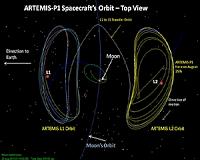 ARTEMIS - The First Earth-Moon Libration Orbiter
Greenbelt MD (SPX) Sep 16, 2010 In August 1960, NASA launched its first communications satellite, Echo 1. Fifty years later, NASA has achieved another first by placing the ARTEMIS-P1 spacecraft into a unique orbit behind the moon, but not actually orbiting the moon itself. This type of orbit, called an Earth-Moon libration orbit, relies on a precise balancing of the Sun, Earth, and Moon gravity so that a spacecraft can o ... read more |
|
|
| The content herein, unless otherwise known to be public domain, are Copyright 1995-2010 - SpaceDaily. AFP and UPI Wire Stories are copyright Agence France-Presse and United Press International. ESA Portal Reports are copyright European Space Agency. All NASA sourced material is public domain. Additional copyrights may apply in whole or part to other bona fide parties. Advertising does not imply endorsement,agreement or approval of any opinions, statements or information provided by SpaceDaily on any Web page published or hosted by SpaceDaily. Privacy Statement |


 del.icio.us
 Digg
Digg Reddit
 YahooMyWeb
 Google
 Facebook


