
 |
 |
 |
 |
 |
 |
 |
 |
 |

 |

Paris, France (ESA) Sep 24, 2010 ESA's Rosetta mission needs to deliver its lander, Philae, to a site in the southern hemisphere of comet 67P/Churyumov-Gerasimenko, according to a new study of the comet's nucleus. "Southern sites appear to be both the safest and the most scientifically interesting," said Jeremie Lasue, who will be presenting the findings at the European Planetary Science Congress in Rome on Thursday 23rd September. "Churyumov-Gerasimenko is a time capsule holding material from the birth of the Solar System. The nucleus's southern hemisphere has been heavily eroded, so Philae will not have to drill down far to find those pristine samples. At the time of Rosetta's rendezvous, gas will be escaping mainly from the northern hemisphere, so it will be safer for Philae to touch down in the south. In addition due to the orientation of the comet, the southern hemisphere will be protected from extreme temperature variations at the time of delivery," said Lasue. After a ten-year chase, Rosetta is due to begin maneuvers to rendezvous with comet Churyumov-Gerasimenko in May 2014 and go into orbit around the nucleus in August. Philae is scheduled to drop down onto the surface of the nucleus in November. The orbiter and lander will then monitor the comet's evolution over the next 13 months as it approaches the Sun and then travels away again. Lasue and colleagues from the INAF-IASF and IFSI institutes in Rome have developed three-dimensional computer models that predict the activity of Churyumov-Gerasimenko's nucleus from the first few months of Rosetta's initial encounter until the comet's closest approach in August 2015. Comet nuclei are a porous mixture of dust, ice and frozen gases such as carbon dioxide and carbon monoxide. As the nucleus approaches the Sun and starts to heat up, the gases vaporize and the tail, or coma, starts to form. The models predict how heat is transferred through the layered nucleus and the vaporization rates of the ices as the comet approaches the Sun. Churyumov-Gerasimenko's lumpy, diamond-shaped nucleus is tilted at an angle of 45 degrees, which means that the south pole is in the full glare of the Sun at the closest approach. The simulations show that after several orbits close to the Sun, the south pole has been significantly more eroded than the north, potentially giving Philae easy access to pristine cometary material just below the surface. Philae will be able to drill down up to 30 centimeters to collect samples of the cometary soil for on-board analysis. The south also looks to offer the most stable landing conditions. At the time of landing, the northern hemisphere is illuminated and activity due to escaping gas is concentrated there, with up to 30 kg of gas and 50 kg of dust emitted per second. Gas escaping from the comet's interior drags dust grains up to the surfaces. Small dust particles are carried away into the coma, while larger grains build up on the surface, forming a coating known as a dust mantle. The simulations show that a dust mantle approximately 20 centimeters deep will have formed in the southern hemisphere, compared to a coating of just a couple of centimeters in northern regions. "When Philae lands, temperatures at the equator may rise above freezing and could fluctuate by around 150 degrees Celsius. However, the regions close to the south pole will keep more stable temperatures. From our present results, we've concluded that the southern hemisphere promises the best landing sites. As more data on Churyumov-Gerasimenko becomes available to better quantify our results, we will be able to add to the picture and help prepare for a safe landing for Philae," said Maria Cristina De Sanctis, co-author of the study. Another reason for choosing a southern hemisphere landing site is that Philae is powered by solar cells, so will experience higher levels of illumination as the comet approaches the Sun.
Share This Article With Planet Earth
Related Links Rosetta Mission Asteroid and Comet Mission News, Science and Technology

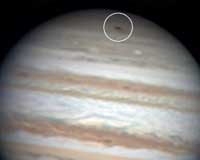 Amateur Astronomers Open Potential Lab In Outer Space For Planetary Scientists
Albuquerque NM (SPX) Sep 13, 2010 Two amateur astronomers who independently observed and videotaped an asteroid striking the giant planet Jupiter on June 3 have opened the possibility, in effect, of a giant research lab in space for planetary scientists. According to a paper by professional astronomers, expected to be published online by Astrophysical Journal Letters, the asteroid was eight to 13 meters in diameter and pac ... read more |
|
|
| The content herein, unless otherwise known to be public domain, are Copyright 1995-2010 - SpaceDaily. AFP and UPI Wire Stories are copyright Agence France-Presse and United Press International. ESA Portal Reports are copyright European Space Agency. All NASA sourced material is public domain. Additional copyrights may apply in whole or part to other bona fide parties. Advertising does not imply endorsement,agreement or approval of any opinions, statements or information provided by SpaceDaily on any Web page published or hosted by SpaceDaily. Privacy Statement |


 del.icio.us
 Digg
Digg Reddit
 YahooMyWeb
 Google
 Facebook


