
 |
 |
 |
 |
 |
 |
 |
 |
 |

 |

Moscow, Russia (RIA Novosti) Jul 16, 2010 Test launches of Russia's new booster rocket, the Angara, are to start in 2013, the rocket designer said on Thursday. Vladimir Nesterov, head of the Khrunichev State Research and Production Space Center, said the rocket assembly would be completed in the first quarter of 2011, adding that the first-stage engine was "99% ready" and the second-stage engine had already been tested three times. He said the only problem that could affect the schedule of tests was delays in the purchase of ground-based equipment that the center was unable to order due to underfunding. Angara rockets, designed to provide lifting capabilities between 2,000 and 40,500 kg into low earth orbit, are expected to become the core of Russia's unmanned launcher fleet, replacing several existing systems. The main purpose of the Angara rocket family is to give Russia independent access to space. The rockets will reduce Russia's dependence on the Baikonur space center it leases from Kazakhstan by allowing the launch of heavy payloads from more northerly sites such as Plesetsk and a new space center in Russia's Far East. Khrunichev is also developing a super-heavy-lift version, the Angara 7, capable of orbiting payloads of 45 to 75 tons, and for which there is no equivalent in Russia's current rocket fleet.
Source: RIA Novosti
Share This Article With Planet Earth
Related Links Khrunichev Space Center Rocket Science News at Space-Travel.Com

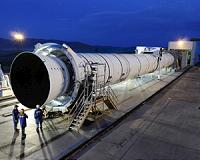 NASA Preparing For DM-2 Test: Now That's Powerful Information
Huntsville AL (SPX) Jul 08, 2010 Preparations are under way for the testing of NASA's next-generation, five-segment solid rocket development motor - DM-2 - in September. The test is designed to advance the understanding, safety, technology and capability of solid rocket motors. The five-segment DM-2 motor - capable of producing 22 million horsepower and generating as much as 3.6 million pounds of thrust - was developed by ... read more |
|
|
| The content herein, unless otherwise known to be public domain, are Copyright 1995-2010 - SpaceDaily. AFP and UPI Wire Stories are copyright Agence France-Presse and United Press International. ESA Portal Reports are copyright European Space Agency. All NASA sourced material is public domain. Additional copyrights may apply in whole or part to other bona fide parties. Advertising does not imply endorsement,agreement or approval of any opinions, statements or information provided by SpaceDaily on any Web page published or hosted by SpaceDaily. Privacy Statement |


 del.icio.us
 Digg
Digg Reddit
 YahooMyWeb
 Google
 Facebook


