
 |
 |
 |
 |
 |
 |
 |
 |
 |

 |

Moscow (UPI) Sep 22, 2010 The Russian Federation has destroyed 19,300 tons of Soviet-era chemical weapons stockpiles. Minpromtorg head Viktor Kholstov presented a report on the ongoing chemical weapons elimination program to a meeting of the Federation Council Committee on Defense and Security, Komsomol'skaia Pravda reported. Kholstov told committee members that the destroyed weapons represent 48.3 percent of Russia's remaining existing stockpiles, adding, "It means that we fully complied with the third stage of target dates for the destruction of stockpiles of chemical weapons. The main source of financing for the destruction of chemical weapons stockpiles -- is the federal budget." Kholstov said that when the first stage of the destruction was completed April 29, 2003, the amount of destroyed ammunition was 400 tons, with an additional 8,000 tons eliminated up to April 2007. Under the third phase of the program, 18,000 tons, or 45 percent of all remaining stocks were to be destroyed. "However, this task was completed last Nov. 25 and by Sept. 1 this year we have already destroyed 19.3 thousand tons of weapons," Kholstov added. In the current year the Russian government has budgeted $645 million for the destruction of the weaponry. Earlier this month representatives from the Organization for the Prohibition of Chemical Weapons visited the Pochep Chemical Weapons Destruction Facility, at Pochep, in Bryansk oblast to observe the destruction process first-hand. The delegation included Ambassador Jean-Francois Blarel, with a representative from each of the other regional groups, a representative from the United States and OPCW Director General Ahmet Uzumcu. The Pochep chemical weapons destruction facility will destroy 7,498 tons of nerve agents stored in air-delivered chemical munitions, which represent 18.8 percent of the chemical weapons stockpile declared by the Russian Federation, with operations scheduled to begin shortly. When the Soviet Union collapsed in December 1991 it held the world's largest stockpiles of chemical and biological weapons. In 1997 the Russian Federation declared stockpiles of 39,967 tons of chemical weapons. These included blister agents Lewisite, mustard, Lewisite-mustard-mix (HL) and nerve agents Sarin, Soman, and VX. Viral agents weaponized by the Soviet Union included tularemia, epidemic typhus, Q fever, smallpox, plague, anthrax, Venezuelan equine encephalomyelitis, Glanders, brucellosis, Marburg, Ebola, AIDS, Junin virus (Argentinean hemorrhagic fever), Machupo virus (Bolivian hemorrhagic fever), yellow fever, Lassa fever, Japanese encephalitis and Russian spring-summer encephalitis. Both Germany and Switzerland provided aid and technical assistance to the construction of the Pochep facility.
Share This Article With Planet Earth
Related Links The latest in Military Technology for the 21st century at SpaceWar.com

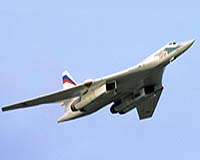 Russia's Kazan Aircraft Plant To Build Next Gen Bomber
Nizhny Novgorod, Russia (RIA Novosti) Sep 17, 2010 The Kazan aircraft maker will start manufacturing a new strategic bomber, Prime Minister Vladimir Putin said on Tuesday. The plant will continue upgrading Tu-160 and Tu-22 long-range bombers and will then "start assembling a new-generation strategic bomber," he said. He offered no indication of the new bomber's specifications or exactly when production would start. Another Kaza ... read more |
|
|
| The content herein, unless otherwise known to be public domain, are Copyright 1995-2010 - SpaceDaily. AFP and UPI Wire Stories are copyright Agence France-Presse and United Press International. ESA Portal Reports are copyright European Space Agency. All NASA sourced material is public domain. Additional copyrights may apply in whole or part to other bona fide parties. Advertising does not imply endorsement,agreement or approval of any opinions, statements or information provided by SpaceDaily on any Web page published or hosted by SpaceDaily. Privacy Statement |


 del.icio.us
 Digg
Digg Reddit
 YahooMyWeb
 Google
 Facebook


