
 |
 |
 |
 |
 |
 |
 |
 |
 |

 |

Moscow (AFP) Oct 29, 2010 Russia on Friday successfully test-fired the nuclear-capable Bulava intercontinental missile, the defence ministry said. The launch is the second successful firing this month after a string of embarrassing failures brought the programme to a halt for 10 months. "The parameters of the trajectory worked out as planned and the warheads successfully landed at the Kura firing area," a defense ministry spokesman said in a statement quoted by Russian news agencies. The missile was fired early morning from Dmitry Donskoy submarine in the White Sea in northwestern Russia, and hit the Kura firing area on the Kamchatka peninsula on the Pacific Ocean, 6,000 kilometres (3,700 miles) away. The launch confirmed that Bulava's many failures were most likely caused by "assembly technology," said a source in the commission established to analyse the missile's production process and pinpoint what was causing it to fail. Another launch, the 15th in all, is scheduled before the end of the year, the source said, Interfax reported. The Bulava, which can be equipped with up to 10 individually targeted nuclear warheads, has a maximum range of 8,000 kilometres. The missile is designed for use with Russia's new Borei class of nuclear submarines like the Yury Dolgoruky and Alexander Nevsky. Analysts have said the vessels risk being worthless unless the Bulava works.
earlier related report The armed forces started by launching a Topol RS-12M missile (called the SS-25 Sickle by NATO) from Plesetsk cosmodrome in the far north of Russia from where it landed on target in the Kamchatka peninsula on the Pacific Ocean. Topol intercontinental missiles have a range of 10,000 kilometres (6,250 miles). They were first tested in 1983 and incorporated into the Soviet Union's nuclear arsenal in 1988. They were originally designed to be used for 10 years. Russian forces later in the day launched two intercontinental missiles from nuclear submarines in northern seas, according to military sources cited by Russian agencies. The first was a P-29P (RSM-50) missile, with a range of 6,500 kilometres, which can be launched from a depth of 50 metres (160 feet). Minutes later, forces launched a Sineva missile (referred to as Skiff by NATO) from the Barents Sea. The missile was incorporated into Russia's arsenal in 2007 and in 2008 recorded its longest ever range of 11,547 kilometres. The three successful tests "confirmed the high specifications of the missiles and the combat capacities of the country's strategic nuclear forces," a defence ministry spokesman told the Interfax news agency.
Share This Article With Planet Earth
Related Links Learn about nuclear weapons doctrine and defense at SpaceWar.com Learn about missile defense at SpaceWar.com All about missiles at SpaceWar.com Learn about the Superpowers of the 21st Century at SpaceWar.com

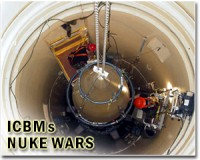 US nuclear missiles go offline after computer glitch: report
Washington (AFP) Oct 26, 2010 A series of suspected computer glitches took a ninth of the US nuclear inter-continental missile stockpile offline over the weekend, CBS News reported Tuesday. CBS said 50 of the 450 ICBMs in America's arsenal went out of communication for about an hour on Saturday at F.E. Warren Air Force Base in central Wyoming, one of three holding bases - the other two are in neighboring North Dakota an ... read more |
|
|
| The content herein, unless otherwise known to be public domain, are Copyright 1995-2010 - SpaceDaily. AFP and UPI Wire Stories are copyright Agence France-Presse and United Press International. ESA Portal Reports are copyright European Space Agency. All NASA sourced material is public domain. Additional copyrights may apply in whole or part to other bona fide parties. Advertising does not imply endorsement,agreement or approval of any opinions, statements or information provided by SpaceDaily on any Web page published or hosted by SpaceDaily. Privacy Statement |


 del.icio.us
 Digg
Digg Reddit
 YahooMyWeb
 Google
 Facebook


