
 |
 |
 |
 |
 |
 |
 |
 |
 |

 |

Canberra, Australia (SPX) Nov 11, 2010 Following a study of what is in effect a miniature galaxy buried inside a normal-sized one - like a Russian doll - astronomers using a CSIRO telescope have concluded that massive black holes are more powerful than we thought. An international team of astronomers led by Dr Manfred Pakull at the University of Strasbourg in France has discovered a 'microquasar' - a small black hole, weighing only as much as a star, that shoots jets of radio-emitting particles into space. Called S26, the black hole sits inside a regular galaxy called NGC 7793, which is 13M light-years away in the Southern constellation of Sculptor. Earlier this year Pakull and colleagues observed S26 with optical and X-ray telescopes (the European Southern Observatory's Very Large Telescope and NASA's Chandra space telescope). Now they have made new observations with CSIRO's Compact Array radio telescope near Narrabri, NSW. These show that S26 is a near-perfect analogue of the much larger 'radio galaxies' and 'radio quasars'. Powerful radio galaxies and quasars are almost extinct today, but they dominated the early Universe, billions of years ago, like cosmic dinosaurs. They contain big black holes, billions of times more massive than the Sun, and shoot out huge radio jets that can stretch millions of light-years into space. Astronomers have been working for decades to understand how these black holes form their giant jets, and how much of the black hole's energy those jets transmit to the gas they travel through. That gas is the raw material for forming stars, and the effects of jets on star-formation have been hotly debated. "Measuring the power of black hole jets, and therefore their heating effect, is usually very difficult," said co-author Roberto Soria (University College London), who carried out the radio observations. "With this unusual object, a bonsai radio quasar in our own backyard, we have a unique opportunity to study the energetics of the jets." Using their combined optical, X-ray and radio data, the scientists were able to determine how much of the jet's energy went into heating the gas around it, and how much went into making the jet glow at radio wavelengths. They concluded that only about a thousandth of the energy went into creating the radio glow. "This suggests that in bigger galaxies too the jets are about a thousand times more powerful than we'd estimate from their radio glow alone," said Dr Tasso Tzioumis of CSIRO Astronomy and Space Science. "That means that black hole jets can be both more powerful and more efficient than we thought, and that their heating effect on the galaxies they live in can be stronger." The study was made possible by a recent upgrade to the Compact Array, which can now do work of this kind five times faster than before.
Share This Article With Planet Earth
Related Links CSIRO Astronomy and Space Science Understanding Time and Space

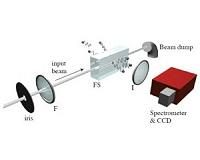 Simulating Black Hole Radiation With Lasers
Washington DC (SPX) Nov 09, 2010 A team of Italian scientists has fired a laser beam into a hunk of glass to create what they believe is an optical analogue of the Hawking radiation that many physicists expect is emitted by black holes. Although the laser experiment superficially bears little resemblance to ultra-dense black holes, the mathematical theories used to describe both are similar enough that confirmation of las ... read more |
|
|
| The content herein, unless otherwise known to be public domain, are Copyright 1995-2010 - SpaceDaily. AFP and UPI Wire Stories are copyright Agence France-Presse and United Press International. ESA Portal Reports are copyright European Space Agency. All NASA sourced material is public domain. Additional copyrights may apply in whole or part to other bona fide parties. Advertising does not imply endorsement,agreement or approval of any opinions, statements or information provided by SpaceDaily on any Web page published or hosted by SpaceDaily. Privacy Statement |


 del.icio.us
 Digg
Digg Reddit
 YahooMyWeb
 Google
 Facebook


