|
|
|
|
|
|
|
|
|
|
|


| . |  |
. |
|
|
|
 by Staff Writers Paris (ESA) Oct 05, 2012
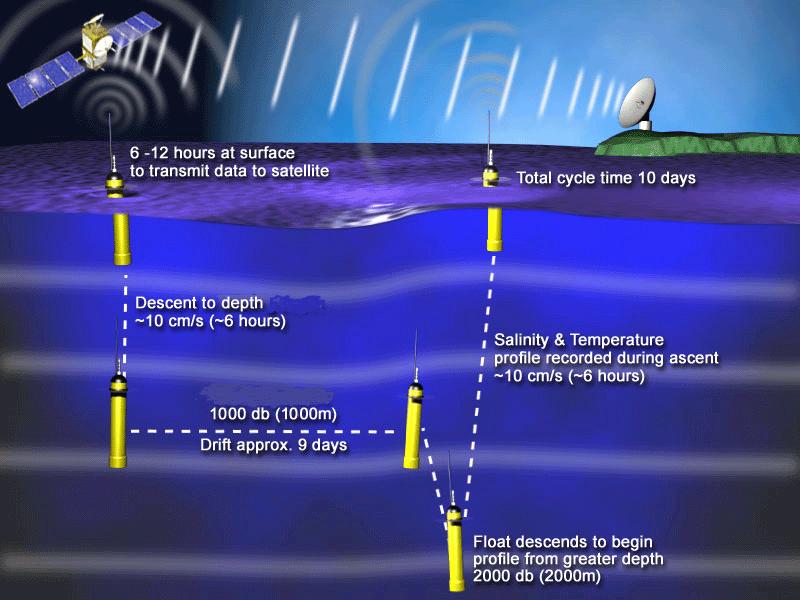
Earth observation measurements shouldn't be taken with a pinch of salt. ESA is comparing readings of sea-surface salinity from drifting floats to confirm the SMOS water mission's measurements. Since its launch in 2009, ESA's Soil Moisture and Ocean Salinity (SMOS) satellite has been helping us to understand the water cycle. As with any Earth observation mission, it is important to validate the readings acquired from space. This involves comparing the satellite data with measurements taken directly in the water. For SMOS, that means comparing its readings to data from floats or drifters that measure ocean salinity at different depths. One of the major networks of in-situ drifters is Argo. The network, involving over 50 research and operational agencies in more than 30 countries, uses autonomous floats to collect temperature, salinity and deep current data. With over 3500 active drifters, the Argo floats acquire in situ data in the upper 2000 m of the ocean. These measurements are then directly compared to SMOS data, which in turn cover the global ocean and provide measurements of the salinity in the first centimetre of the sea surface. SMOS provides measurements averaged over a surface of 40x40 sq km, but the difference of the size of the area measured and other influencing factors like background noise lead to differences between SMOS and Argo measurements. "Since Argo measurements are taken much deeper than SMOS's, the stratification of the upper layer of the ocean needs to be taken into account when comparing the two salinities in rainy regions," said Jacqueline Boutin from France's Laboratory for Oceanography and Climate (LOCEAN). "For example, rain over the ocean will cause SMOS to pick up lower salinity readings than Argo." The advantage that SMOS has over the Argo floats is that the satellite provides a complete view of the global ocean every five days. Argo measurements, on the other hand, provide punctual salinity data sampled at a lower resolution than SMOS every 10 days. The higher precision provided by the Argo floats, however, complements the SMOS measurements.
Related Links SMOS Earth Observation News - Suppiliers, Technology and Application
|
|
|
| The content herein, unless otherwise known to be public domain, are Copyright 1995-2014 - Space Media Network. AFP, UPI and IANS news wire stories are copyright Agence France-Presse, United Press International and Indo-Asia News Service. ESA Portal Reports are copyright European Space Agency. All NASA sourced material is public domain. Additional copyrights may apply in whole or part to other bona fide parties. Advertising does not imply endorsement,agreement or approval of any opinions, statements or information provided by Space Media Network on any Web page published or hosted by Space Media Network. Privacy Statement |

 del.icio.us
 Digg
Digg Reddit
 Google