
 |
 |
 |
 |
 |
 |
 |
 |
 |

 |

Vandenberg AFB CA (SPX) Dec 09, 2010 The Space Tracking and Surveillance System (STSS) Demonstration program satellites, built by Northrop Grumman and Raytheon, detected the test launch of a Minuteman III Intercontinental Ballistic Missile (ICBM) Sept. 17 and tracked it through the boost and post-boost phases for the first time. The single reentry test vehicle from the missile traveled approximately 5,300 miles to a pre-determined point about 200 miles southwest of Guam, according to the U.S. Air Force. The missile defense satellites transmitted tracking data to the Missile Defense Integration and Operations Center at Schriever Air Force Base, Colo., where the information is being analyzed. "STSS acquired the target during the boost phase and continued to track post-boost using multiple track sensor infrared bands for the first time," said Doug Young, vice president of missile defense and missile warning programs for Northrop Grumman's Aerospace Systems sector. "This test demonstrated the ability of STSS to track cold-body objects post-boost, an important capability needed by the Missile Defense Agency for the Ballistic Missile Defense System." Earlier in September, STSS successfully autonomously acquired and tracked a threat representative short range ballistic missile that was launched during an MDA test involving the Airborne Laser Test Bed. The MDA is pursuing the STSS Demonstration program as a space-based sensor component of the BMDS. The satellites are demonstrating the ability of space sensors to provide high-precision, real-time tracking of missiles and midcourse objects, enabling simultaneous theatre, regional, and strategic missile defense. Data from STSS testing is validating the ability to acquire and track missiles in all phases of flight, to close the fire control loop with BMDS interceptors from space and supporting the development of a future operational missile defense satellite constellation.
Share This Article With Planet Earth
Related Links - Military Space News at SpaceWar.com

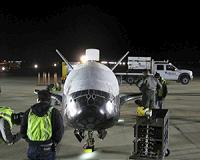 Secret mini-shuttle lands in California
Vandenberg Afb, Calif. (UPI) Dec 3, 2010 An unmanned U.S. military mini-shuttle launched from Cape Canaveral in April glided to an automated landing in California Friday, Air Force officials said. After a 220-day classified mission, the X-37B Orbital Test Vehicle touched down at 4:16 a.m. EST at Vandenberg Air Force Base, Florida Today reported. The OTV-1 is the first U.S. unmanned vehicle to return from orbit and land ... read more |
|
|
| The content herein, unless otherwise known to be public domain, are Copyright 1995-2010 - SpaceDaily. AFP and UPI Wire Stories are copyright Agence France-Presse and United Press International. ESA Portal Reports are copyright European Space Agency. All NASA sourced material is public domain. Additional copyrights may apply in whole or part to other bona fide parties. Advertising does not imply endorsement,agreement or approval of any opinions, statements or information provided by SpaceDaily on any Web page published or hosted by SpaceDaily. Privacy Statement |


 del.icio.us
 Digg
Digg Reddit
 YahooMyWeb
 Google
 Facebook


