
 |
 |
 |
 |
 |
 |
 |
 |
 |

 |
Satellite traffic control system urged
Vienna (UPI) Feb 18, 2009 Last week's collision of U.S. and Russian satellites has prompted the call for creation of an International Civil Space Situational Awareness system. Brian Weeden, a consultant for the Secure World Foundation in Superior, Colo., proposed the concept Tuesday in Vienna during a meeting of a subcommittee of the U.N. Committee on the Peaceful Uses of Outer Space. Weeden said the collision produced an enormous amount of orbiting debris that is threatening spacecraft launched by several nations. "The owner or operator of a particular satellite usually has excellent knowledge about the position of that satellite in space, but little to no information about the locations of other objects around them," he told the subcommittee, noting the concept has been a part of military space activities for years, but there's also a need for such a system in the civil world. "Such a network is very expensive to create and maintain, and only the United States has thus far developed one," Weeden said. "And while the United States' space surveillance network does provide the most complete SSA data in the world, it still has significant limitations due to the lack of coverage in areas where the United States does not have a presence." He said such an informational system "could not only mitigate future collisions, but enhance cooperation, transparency and future space governance issues." Share This Article With Planet Earth
Related Links Space Technology News - Applications and Research
 The Problem Of Space Junk
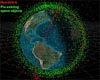 Moscow (RIA) Feb 17, 2009
When it launched its first satellite, humankind not only opened a window on the Universe, but also unveiled a sort of garbage chute, which is quickly turning near-Earth space into a gigantic waste dump filled with space and rocket debris. |
|
|

| The content herein, unless otherwise known to be public domain, are Copyright 1995-2007 - SpaceDaily.AFP and UPI Wire Stories are copyright Agence France-Presse and United Press International. ESA Portal Reports are copyright European Space Agency. All NASA sourced material is public domain. Additional copyrights may apply in whole or part to other bona fide parties. Advertising does not imply endorsement,agreement or approval of any opinions, statements or information provided by SpaceDaily on any Web page published or hosted by SpaceDaily. Privacy Statement |
 del.icio.us
 Digg
Digg Reddit
 YahooMyWeb
 Google
 Facebook