
 |
 |
 |
 |
 |
 |
 |
 |
 |

 |

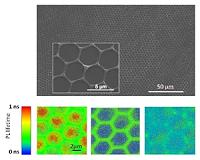
Los Alamos NM (SPX) Nov 08, 2010 Scientists at the U.S. Department of Energy's Los Alamos National Laboratory and Brookhaven National Laboratory have fabricated transparent thin films capable of absorbing light and generating electric charge over a relatively large area. The material, described in the journal Chemistry of Materials, could be used in development of transparent solar panels. "Potentially, with future refinement of this technology, windows in a home or office could generate solar power," said Hsing-Lin Wang, a co-corresponding author of the paper and a researcher in the Chemistry Division at Los Alamos. The new material is a semiconducting polymer spiked with "fullerenes"-soccer-ball-shaped, cage-like molecules composed of 60 carbon atoms. When applied to a surface under carefully controlled conditions, the material self-assembles in a repeating pattern of micron-sized hexagonal-shaped cells resembling a honeycomb. Researchers created reproducible films of up to several square millimeters in area. The material is largely transparent because the polymer chains pack together at the edges of the hexagons, remaining loosely packed and relatively thin across the centers. The densely packed edges strongly absorb light and could facilitate electrical conductivity, according to the researchers. "Though such honeycomb-patterned thin films have previously been made using conventional polymers like polystyrene, this is the first report of such a material that blends semiconductors and fullerenes to absorb light and efficiently generate charge and charge separation," said lead scientist Mircea Cotlet, a physical chemist at Brookhaven's Center for Functional Nanomaterials (CFN). Perfecting large-scale application of the material could enable a wide range of practical applications, such as energy-generating solar windows, or new types of optical displays. The researchers fabricated the thin films by creating a flow of micron-sized (about 1/100th the width of a human hair) water droplets across a thin layer of the polymer-fullerene solution. The droplets assembled themselves into arrays within the polymer solution. Once the water evaporated, the scientists were left with thin films of polymer in a honeycomb pattern. The deposition method is cost effective and potentially scalable to industrial size. The research was supported at Los Alamos by the DOE Office of Science. The work was also carried out in part at Office of Science User Facilities CFN and the Center for Integrated Nanotechnologies. The Brookhaven team included Mircea Cotlet, Zhihua Xu, and Ranjith Krishna Pai. Collaborators from Los Alamos include Hsing-Lin Wang and Hsinhan Tsai, who are both users of the CFN facilities at Brookhaven, Andrew Dattelbaum from the Center for Integrated Nanotechnologies, and project leader Andrew Shreve of the Materials Physics and Applications Division.
Share This Article With Planet Earth
Related Links DOE/Los Alamos National Laboratory Powering The World in the 21st Century at Energy-Daily.com

 Transparent Conductive Material Could Lead To Power-Generating Windows
Upton NY (SPX) Nov 08, 2010 Scientists at the U.S. Department of Energy's (DOE) Brookhaven National Laboratory and Los Alamos National Laboratory have fabricated transparent thin films capable of absorbing light and generating electric charge over a relatively large area. The material, described in the journal Chemistry of Materials, could be used to develop transparent solar panels or even windows that absorb solar energy ... read more |
|
|
| The content herein, unless otherwise known to be public domain, are Copyright 1995-2010 - SpaceDaily. AFP and UPI Wire Stories are copyright Agence France-Presse and United Press International. ESA Portal Reports are copyright European Space Agency. All NASA sourced material is public domain. Additional copyrights may apply in whole or part to other bona fide parties. Advertising does not imply endorsement,agreement or approval of any opinions, statements or information provided by SpaceDaily on any Web page published or hosted by SpaceDaily. Privacy Statement |


 del.icio.us
 Digg
Digg Reddit
 YahooMyWeb
 Google
 Facebook


