
 |
 |
 |
 |
 |
 |
 |
 |
 |

 |

Seattle (UPI) Sep 9, 2010 A U.S. space telescope set for launch in 2014 could reveal the presence of oceans on planets outside the solar system, scientists say. Detecting water on Earth-like planets would offer the tantalizing prospect they could sustain life, and scientists hope the reflection of light, or "glint", from mirror-like ocean surfaces could be picked up by the upcoming generation of space telescopes, the BBC reported Thursday. Tyler Robinson at the University of Washington in Seattle said he thinks the new technique could be used in the search for the "holy grail" for exoplanet astronomy, a possible sister planet to Earth. "We're focusing on a class of extra-solar planets yet to be detected, things comparable in size and composition to the Earth and similar distances from their central star as the Earth is from the Sun," he said. "The goal is to find something Earth-like in almost every sense of the world so we can even prove it has liquid oceans on its surface." Robinson said he hopes "glint" -- the effect seen when light is reflected from an ocean's surface -- may reveal the presence of Earth-like planets beyond our cosmic neighborhood. Presently, clues like tell-tale glint spots are vital to finding Earth-like planets because astronomers are decades away from being able to directly image the surface of these alien worlds 20 or 30 light-years away.
Share This Article With Planet Earth
Related Links Lands Beyond Beyond - extra solar planets - news and science Life Beyond Earth

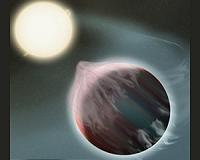 Deadly Tides Mean Early Exit For Hot Jupiters
Greenbelt MD (SPX) Sep 10, 2010 Bad news for planet hunters: most of the "hot Jupiters" that astronomers have been searching for in star clusters were likely destroyed long ago by their stars. In a paper accepted for publication by the Astrophysical Journal, John Debes and Brian Jackson of NASA's Goddard Space Flight Center in Greenbelt, Md., offer this new explanation for why no transiting planets (planets that pass in ... read more |
|
|
| The content herein, unless otherwise known to be public domain, are Copyright 1995-2010 - SpaceDaily. AFP and UPI Wire Stories are copyright Agence France-Presse and United Press International. ESA Portal Reports are copyright European Space Agency. All NASA sourced material is public domain. Additional copyrights may apply in whole or part to other bona fide parties. Advertising does not imply endorsement,agreement or approval of any opinions, statements or information provided by SpaceDaily on any Web page published or hosted by SpaceDaily. Privacy Statement |


 del.icio.us
 Digg
Digg Reddit
 YahooMyWeb
 Google
 Facebook


