|
 |
 |
 |
 |
 |
 |
 |

| . |  |
. |

|
|
. |

 by Staff Writers Washington (AFP) June 15, 2011
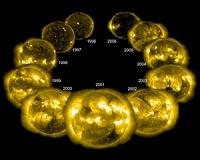
US scientists say the familiar sunspot cycle seems to be entering a hibernation period unseen since the 17th century, a pattern that could have a slight cooling effect on global temperatures. For years, scientists have been predicting the Sun would by around 2012 move into solar maximum, a period of intense flares and sunspot activity, but lately a curious calm has suggested quite the opposite. The signs include a missing jet stream, fading spots and slower activity near the poles, said a trio of studies presented Tuesday at the annual meeting of the American Astronomical Society's Solar Physics Division in Las Cruces, New Mexico. "This is highly unusual and unexpected," said Frank Hill, associate director of the National Solar Observatory's Solar Synoptic Network. "But the fact that three completely different views of the Sun point in the same direction is a powerful indicator that the sunspot cycle may be going into hibernation." Solar activity tends to rise and fall every 11 years or so. The solar maximum and solar minimum each mark about half the interval of the magnetic pole reversal on the Sun, which happens every 22 years. Experts are now probing whether this period of inactivity could be a second Maunder Minimum, a 70-year period when hardly any sunspots were observed between 1645-1715 known as the "Little Ice Age." "If we are right, this could be the last solar maximum we'll see for a few decades. That would affect everything from space exploration to Earth's climate," said Hill. Solar flares and eruptions can send highly charged particles hurtling toward Earth and interfere with satellite communications, GPS systems and even airline controls. Geomagnetic forces have been known to occasionally garble the world's modern gadgetry, and warnings were issued as recently as last week when a moderate solar flare sent a fiery coronal mass ejection in the Earth's direction. However, the temperature change associated with any reduction in sunspot activity would likely be minimal and not enough to offset the impact of greenhouse gases on global warming, according to scientists. "Recent solar 11-year cycles are associated empirically with changes in global surface temperature of 0.1 Celsius," said Judith Lean, a solar physicist with the US Naval Research Laboratory. If the cycle were to stop or slow down, the small fluctuation in temperature would do the same, eliminating the slightly cooler effect of a solar minimum compared to the warmer solar maximum. The phenomenon was witnessed during the descending phase of the last solar cycle. This "cancelled part of the greenhouse gas warming of the period 2000-2008, causing the net global surface temperature to remain approximately flat -- and leading to the big debate of why the Earth hadn't (been) warming in the past decade," Lean, who was not involved in the three studies presented, told AFP. Less sunspot activity means the Sun will radiate lower levels of energy, ultraviolet rays, solar wind and a weaker magnetic field, explained climate scientist and author Rasmus Benestad of the Norwegian Meteorological Institute. "Historical data suggest that solar activity, however, only appears to have a weak effect on our climate," said Benestad. A study in the March 2010 issue of Geophysical Research Letters explored what effect an extended solar minimum might have, and found no more than a 0.3 Celsius dip by 2100 compared to normal solar fluctuations. "A new Maunder-type solar activity minimum cannot offset the global warming caused by human greenhouse gas emissions," wrote authors Georg Feulner and Stefan Rahmstorf, noting that forecasts by the Intergovernmental Panel on Climate Change forecast a maximum 4.5 degree Celsius rise by this century's end compared to the latter half of the 20th century. "Moreover, any offset of global warming due to a grand minimum of solar activity would be merely a temporary effect, since the distinct solar minima during the last millennium typically lasted for only several decades or a century at most." Other experts were skeptical about whether the latest data actually predict a long-term solar minimum. "There is no compelling reason to think that the Sun is about to go into hibernation," said Yi-Ming Wang of the Naval Research Laboratory. "On the other hand, we don't understand the solar dynamo well enough to make any reliable prediction about what cycle 25 will be like."
|
. |
|
| The content herein, unless otherwise known to be public domain, are Copyright 1995-2011 - Space Media Network. AFP and UPI Wire Stories are copyright Agence France-Presse and United Press International. ESA Portal Reports are copyright European Space Agency. All NASA sourced material is public domain. Additional copyrights may apply in whole or part to other bona fide parties. Advertising does not imply endorsement,agreement or approval of any opinions, statements or information provided by Space Media Network on any Web page published or hosted by Space Media Network. Privacy Statement |

 del.icio.us
 Digg
Digg Reddit
 Google