
 |
 |
 |
 |
 |
 |
 |
 |
 |

 |

Paris, France (SPX) Aug 05, 2010 Astronomers using ESO's Very Large Telescope have for the first time obtained a three-dimensional view of the distribution of the innermost material expelled by a recently exploded star. The original blast was not only powerful, according to the new results. It was also more concentrated in one particular direction. This is a strong indication that the supernova must have been very turbulent, supporting the most recent computer models. Unlike the Sun, which will die rather quietly, massive stars arriving at the end of their brief life explode as supernovae, hurling out a vast quantity of material. In this class, Supernova 1987A (SN 1987A) in the rather nearby Large Magellanic Cloud occupies a very special place. Seen in 1987, it was the first naked-eye supernova to be observed for 383 years, and because of its relative closeness, it has made it possible for astronomers to study the explosion of a massive star and its aftermath in more detail than ever before. It is thus no surprise that few events in modern astronomy have been met with such an enthusiastic response by scientists. SN 1987A has been a bonanza for astrophysicists. It provided several notable observational 'firsts', like the detection of neutrinos from the collapsing inner stellar core triggering the explosion, the localisation on archival photographic plates of the star before it exploded, the signs of an asymmetric explosion, the direct observation of the radioactive elements produced during the blast, observation of the formation of dust in the supernova, as well as the detection of circumstellar and interstellar material. New observations making use of a unique instrument, SINFONI, on ESO's Very Large Telescope (VLT) have provided even deeper knowledge of this amazing event, as astronomers have now been able to obtain the first-ever 3D reconstruction of the central parts of the exploding material. This view shows that the explosion was stronger and faster in some directions than others, leading to an irregular shape with some parts stretching out further into space. The first material to be ejected from the explosion travelled at an incredible 100 million km per hour, which is about a tenth of the speed of light or around 100 000 times faster than a passenger jet. Even at this breakneck speed it has taken 10 years to reach a previously existing ring of gas and dust puffed out from the dying star. The images also demonstrate that another wave of material is travelling ten times more slowly and is being heated by radioactive elements created in the explosion. "We have established the velocity distribution of the inner ejecta of Supernova 1987A," says lead author Karina Kj�r. "Just how a supernova explodes is not very well understood, but the way the star exploded is imprinted on this inner material. We can see that this material was not ejected symmetrically in all directions, but rather seems to have had a preferred direction. Besides, this direction is different to what was expected from the position of the ring." Such asymmetric behaviour was predicted by some of the most recent computer models of supernovae, which found that large-scale instabilities take place during the explosion. The new observations are thus the first direct confirmation of such models. SINFONI is the leading instrument of its kind, and only the level of detail it affords allowed the team to draw their conclusions. Advanced adaptive optics systems counteracted the blurring effects of the Earth's atmosphere while a technique called integral field spectroscopy allowed the astronomers to study several parts of the supernova's chaotic core simultaneously, leading to the build-up of the 3D image. "Integral field spectroscopy is a special technique where for each pixel we get information about the nature and velocity of the gas," says Kj�r. "This means that besides the normal picture we also have the velocity along the line of sight. Because we know the time that has passed since the explosion, and because the material is moving outwards freely, we can convert this velocity into a distance. This gives us a picture of the inner ejecta as seen straight on and from the side."
Share This Article With Planet Earth
Related Links ESO Space Telescope News and Technology at Skynightly.com

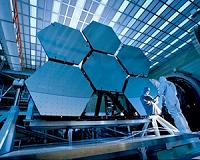 James Webb Space Telescope Completes Cryogenic Mirror Test
Huntsville AL (SPX) Jul 29, 2010 Recently, six James Webb Space Telescope beryllium mirror segments completed a series of cryogenic tests at the X-ray and Cryogenic Facility at NASA's Marshall Space Flight Center in Huntsville, Ala. During testing, the mirrors were subjected to extreme temperatures dipping to -415 degrees Fahrenheit, permitting NASA contractor engineers to measure in extreme detail how the shape of the mi ... read more |
|
|
| The content herein, unless otherwise known to be public domain, are Copyright 1995-2010 - SpaceDaily. AFP and UPI Wire Stories are copyright Agence France-Presse and United Press International. ESA Portal Reports are copyright European Space Agency. All NASA sourced material is public domain. Additional copyrights may apply in whole or part to other bona fide parties. Advertising does not imply endorsement,agreement or approval of any opinions, statements or information provided by SpaceDaily on any Web page published or hosted by SpaceDaily. Privacy Statement |


 del.icio.us
 Digg
Digg Reddit
 YahooMyWeb
 Google
 Facebook


