|
 |
 |
 |
 |
 |
 |
 |

| . |  |
. |

|
|
. |

 by Staff Writers Nantes, France (SPX) Oct 12, 2011
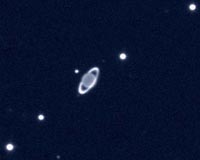
Uranus's highly tilted axis makes it something of an oddball in our Solar System. The accepted wisdom is that Uranus was knocked on its side by a single large impact, but new research to be presented at the EPSC-DPS Joint Meeting in Nantes rewrites our theories of how Uranus became so tilted and also solves fresh mysteries about the position and orbits of its moons. By using simulations of planetary formation and collisions, it appears that early in its life Uranus experienced a succession of small punches instead of a single knock-out blow. This research has important ramifications on our theories of giant planet formation. Uranus is unusual in that its spin axis is inclined by 98 degrees compared to its orbital plane around the Sun. This is far more pronounced than other planets, such as Jupiter (3 degrees), Earth (23 degrees), or Saturn and Neptune (29 degrees). Uranus is, in effect, spinning on its side. The generally accepted theory is that in the past a body a few times more massive than the Earth collided with Uranus, knocking the planet on its side. There is, however, one significant flaw in this notion: the moons of Uranus should have been left orbiting in their original angles, but they too lie at almost exactly 98 degrees. This long-standing mystery has been solved by an international team of scientists led by Alessandro Morbidelli (Observatoire de la Cote d'Azur in Nice, France), who will be presenting his group's research at the EPSC-DPS Joint Meeting in Nantes, France. Morbidelli and his team used simulations to reproduce various impact scenarios in order to ascertain the most likely cause of Uranus' tilt. They discovered that if Uranus had been hit when still surrounded by a protoplanetary disk - the material from which the moons would form - then the disk would have reformed into a fat doughnut shape around the new, highly-tilted equatorial plane. Collisions within the disk would have flattened the doughnut, which would then go onto form the moons in the positions we see today. However, the simulation threw up an unexpected result: in the above scenario, the moons displayed retrograde motion - that is to say, they orbited in the opposite direction to that which we observe. Morbidelli's group tweaked their parameters in order to explain this. The surprising discovery was that if Uranus was not tilted in one go, as is commonly thought, but rather was bumped in at least two smaller collisions, then there is a much higher probability of seeing the moons orbit in the direction we observe. This research is at odds with current theories of how planets form, which may now need adjusting. Morbidelli elaborates: "The standard planet formation theory assumes that Uranus, Neptune and the cores of Jupiter and Saturn formed by accreting only small objects in the protoplanetary disk. They should have suffered no giant collisions. "The fact that Uranus was hit at least twice suggests that significant impacts were typical in the formation of giant planets. So, the standard theory has to be revised." A session overview is available here
- The million outer planets of a star called Sol
|
. |
|
| The content herein, unless otherwise known to be public domain, are Copyright 1995-2011 - Space Media Network. AFP and UPI Wire Stories are copyright Agence France-Presse and United Press International. ESA Portal Reports are copyright European Space Agency. All NASA sourced material is public domain. Additional copyrights may apply in whole or part to other bona fide parties. Advertising does not imply endorsement,agreement or approval of any opinions, statements or information provided by Space Media Network on any Web page published or hosted by Space Media Network. Privacy Statement |

 del.icio.us
 Digg
Digg Reddit
 Google