
 |
 |
 |
 |
 |
 |
 |
 |
 |

 |

Manila (AFP) Sept 24, 2010 Completion of a planned sewerage system for the Philippine capital, which has one of the world's most polluted waterways, is set to be delayed by over 20 years, the environment ministry said Friday. Two private companies had been contracted to build sewerage and treatment plants for the 11-million-strong Metro Manila area, but a planned completion date of 2009 was set to be delayed until about 2031, said Jonas Leones, assistant director of the Environmental Management Bureau. Only a small part of the city's waste water is treated, while most of the rest runs into the Pasig River, described in a 2006 United Nations Development Programme report as one of the world's most polluted waterways. "The Pasig river is the septic tank of Metro Manila," Environment Secretary Ramon Paje admitted before a Senate hearing earlier this week, according to Leones. The government wants to fine the two water concessionaires -- Manila Water and Maynilad -- more than 100 million pesos (2.2 million dollars) for their failure to complete the project on time but the issue has gone to court, Leones said. Domestic waste accounts for some 70 percent of the pollution in the 25-kilometre (16-mile) river. The government is trying several measures to clean up the Pasig but much of the problem is attributed to millions of squatters living in slums on its banks, said an aide to Paje, Anna Liza Te. "This is an urban poor problem. It needs long term solutions like relocation," she said. The World Bank estimates that up to half of Manila residents live in slums.
earlier related report When the San Francisco Public Utilities Commission's $4.6 billion project to overhaul the area's water system is completed in 2015, the Bay Division Pipeline 5 will replace two decaying pipelines that now traverse the bay on wooden trestles, the San Francisco Chronicle reported Friday. "These pipelines are old, and they leak," commission general manager Ed Harrington said. "The question is, do we really want to depend on them in a major earthquake? We really count on this system working, even if others fail." The current water network serves 2.5 million customers in San Francisco, the East Bay and the Peninsula. A failure at the trans-bay pipeline during an earthquake could cut off water to businesses, homes and public service agencies for weeks or even months, officials warn. "This infrastructure was built in the 1920s and 1930s -- it wasn't meant to last this long," Bob Mues, tunnel project construction manager, said. "This is state of the art," he said of the new project. The underground pipeline won't cross any major fault lines, but will lie between the San Andreas and Hayward faults. Because earthquakes cause more shaking at ground level than below it, experts say the pipeline's location is considered more secure.
earlier related report Findings published in the journal Geophysical Research Letters say water is rapidly being pulled from fast-shrinking subterranean reservoirs essential to daily life and agriculture in many regions. So much water is being drawn from below ground that its evaporation and eventual precipitation accounts for about 25 percent of the annual sea level rise across the planet, the researchers said. Global groundwater depletion threatens potential disaster for an increasingly globalized agricultural system, Marc Bierkens of Utrecht University in Utrecht, the Netherlands, said. "If you let the population grow by extending the irrigated areas using groundwater that is not being recharged, then you will run into a wall at a certain point in time, and you will have hunger and social unrest to go with it," Bierkens says. "That is something that you can see coming for miles." The researchers say the rate at which global groundwater stocks are shrinking has more than doubled between 1960 and 2000, increasing the amount lost from 30 cubic miles to 68 cubic miles per year. Because the total amount of the world's groundwater is unknown it's hard to estimate how fast the global supply would vanish at this rate, but if water was drained as rapidly from the Great Lakes they would go bone-dry in around 80 years, scientists say.
Share This Article With Planet Earth
Related Links Water News - Science, Technology and Politics

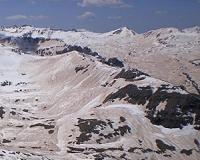 Desert Dust Cuts Colorado River Flow
Pasadena CA (SPX) Sep 23, 2010 Snowmelt in the Colorado River basin is occurring earlier, reducing runoff and the amount of crucial water available downstream. A new study shows this is due to increased dust caused by human activities in the region during the past 150 years. The study, led by a NASA scientist and funded by the agency and the National Science Foundation, showed peak spring runoff now comes three weeks ea ... read more |
|
|
| The content herein, unless otherwise known to be public domain, are Copyright 1995-2010 - SpaceDaily. AFP and UPI Wire Stories are copyright Agence France-Presse and United Press International. ESA Portal Reports are copyright European Space Agency. All NASA sourced material is public domain. Additional copyrights may apply in whole or part to other bona fide parties. Advertising does not imply endorsement,agreement or approval of any opinions, statements or information provided by SpaceDaily on any Web page published or hosted by SpaceDaily. Privacy Statement |


 del.icio.us
 Digg
Digg Reddit
 YahooMyWeb
 Google
 Facebook


