|
 |
 |
 |
 |
 |
 |
 |
 |

 |
Spacewalkers To Test New Shuttle Repair Techniques
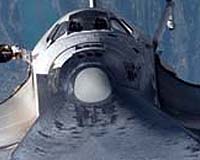
Washington (AFP) March 20, 2008 Two astronauts stepped into the void Thursday in a spacewalk to try out new repair techniques on shuttle Endeavour's heat shield, a crucial test for an upcoming mission to the orbiting Hubble Space Telescope. Astronauts Robert Behnken and Mike Foreman, who arrived at the International Space Station (ISS) aboard Endeavour last week, floated out of the ISS's depressurization chamber for a near seven-hour spacewalk, NASA said. NASA wants to make sure astronauts can fix any potential damage during the Hubble mission on August 28, since the shuttle would be parked too far from the ISS, its only habitable shelter in orbit. Astronauts have been testing different in-space repair techniques on the shuttle's protective layer since a crack in Columbia's heat shield caused it to explode while re-entering Earth in 2003, killing its seven-member crew. But every mission since Columbia has been to the ISS, which would serve as a shelter for astronauts while they wait for a rescue mission in case their shuttle suffers irreparable damage. The Hubble telescope does not offer such a safe haven. NASA has used special cameras to scan the shuttle's thermal tiles during flights to make sure they were not damaged by debris during liftoff or by micrometeorites while orbiting the Earth. Columbia's heat shield was hit by debris during takeoff. In addition to in-flight inspections, astronauts have also tested heat-shield repair techniques during spacewalks. Before testing the new repair methods Thursday, Behnken and Foreman replaced a failed circuit breaker on the space station's truss. "Nicely done Bob," a mission control official told Behnken after the repair. The spacewalkers then floated to another part of the station to spread a pasty material on cracked sample tiles with a caulk-gun-like tool. NASA wants to see how the material performs in amicrogravityandvacuumenvironment. The samples will be brought back to Earth to undergo extensive tests under extreme temperatures the tiles would need to withstand during a shuttle's super-heated return into Earth's atmosphere. At 25 times the speed of sound, the shuttle's re-entry into the atmosphere generates up to 1,500 degrees Celsius (2,700 Fahrenheit) on some of the thermal tiles that line its underbelly. Thursday's spacewalk will be the fourth of the Endeavour mission, a 16-day trip that has already included major achievements, including the installation on the ISS of the first part of Japan's Kibo laboratory and Canada's Dextre robot. Future shuttle missions will deliver Kibo's two other parts, which will give Japan a foothold in the ISS alongside the United States, Russia and Europe, whose Columbus lab was delivered last month. The microgravity research aboard the ISS is considered a crucial step toward long human missions on the moon and eventually Mars. Endeavour's crew will conduct a fifth and final spacewalk Saturday before the shuttle undocks from the ISS Monday for its March 26 return to Earth. NASA wants to complete construction of the ISS by 2010, when its three-shuttle fleet is scheduled to be retired. Community Email This Article Comment On This Article Related Links Shuttle at NASA Watch NASA TV via Space.TV Space Shuttle News at Space-Travel.Com
 NASA puzzles over mysterious 10-second debris
 Washington (AFP) March 12, 2008
Endeavour astronauts inspected the space shuttle's heat shield Wednesday, while NASA puzzled over a mysterious piece of debris that may have struck the shuttle's nose just after launch. |
|
|

| The content herein, unless otherwise known to be public domain, are Copyright 1995-2007 - SpaceDaily.AFP and UPI Wire Stories are copyright Agence France-Presse and United Press International. ESA Portal Reports are copyright European Space Agency. All NASA sourced material is public domain. Additional copyrights may apply in whole or part to other bona fide parties. Advertising does not imply endorsement,agreement or approval of any opinions, statements or information provided by SpaceDaily on any Web page published or hosted by SpaceDaily. Privacy Statement |