
 |
 |
 |
 |
 |
 |
 |
 |
 |

 |

Madrid, Spain (SPX) May 23, 2011 Researchers from the King Juan Carlos University (URJC) have carried out a research study published in Biological Conservation, which looked at whether spiders were more tolerant of human impact than other animals. The answer was no: arachnids suffer the consequences of changes to their landscape just like any other animal. "The abundance and number of spider species is negatively affected by the impact of many human land uses, such as habitat fragmentation, fire and pesticides", Samuel Prieto-Benitez and Marcos Mendez, researchers at the URJC Biodiversity and Conservation Department, tell SINC. Given the "scarcity" of threatened spiders on the Red Lists, which are very in vogue at the moment, the researchers tried to find out whether spiders are exempt from the risks caused by human action, by means of a meta-study of a total of 173 scientific papers published since 1980, which provide more generalizable data. "The technique used meant we could rigorously combine the results of a lot of studies. This is regularly used in medicine in order to arrive at general conclusions about the effects of drugs, based on numerous trials with more limited coverage", say Prieto-Benitez and Mendez, who studied the human impact in three ecosystems: farmland, pasture and woodland. Until now, fewer than 20% of studies had indicated any negative effects of human impact on arachnids. The study, which has been published in Biological Conservation, demonstrates "evident" damaging effects on spider numbers due to the use of soil in farming and pasture systems. "In woodlands this was not so clear", the study explains.
Growing threats Insecticides also have a negative effect on spider diversity in agricultural and pasture ecosystems. The researchers show in the study that organic farming is more beneficial to arachnid abundance than conventional agriculture, but that these effects depend on the complexity of the landscape. The study proposes some solutions for spider conservation. A reduction in mechanical alterations to the land, such as harvesting, ploughing and grazing would increase spider diversity in agricultural and pastural ecosystems. In addition, the use of insecticides should be more controlled, as in organic farming, and habitat fragmentation should be avoided. According to the authors, although "they do not enjoy an excessive level of public sympathy", spiders are an important animal group for humans, since they free us of a large number of pest insects and are "very important" predators in the functioning of natural systems. Prieto-Benitez, Samuel; Mendez, Marcos. "Effects of land management on the abundance and richness of spiders (Araneae): A meta-analysis" Biological Conservation 144(2): 683-691, February 2011. DOI:10.1016/j.biocon.2010.11.024
Share This Article With Planet Earth
Related Links FECYT - Spanish Foundation for Science and Technology Darwin Today At TerraDaily.com

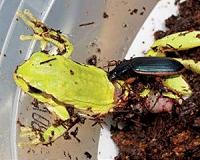 Small insects attacks and kill amphibians much bigger than themselves
London, UK (SPX) May 23, 2011 New findings of researchers from Tel-Aviv University show that predator-prey interactions between ground beetles of the genus Epomis and amphibians are much more complex than expected. The study was published in the open access journal Zoo Keys. "Amphibians are typical insect predators and their diet may include adult beetles, ground beetles in particular. The recently filmed successful at ... read more |
|
|
| The content herein, unless otherwise known to be public domain, are Copyright 1995-2010 - SpaceDaily. AFP and UPI Wire Stories are copyright Agence France-Presse and United Press International. ESA Portal Reports are copyright European Space Agency. All NASA sourced material is public domain. Additional copyrights may apply in whole or part to other bona fide parties. Advertising does not imply endorsement,agreement or approval of any opinions, statements or information provided by SpaceDaily on any Web page published or hosted by SpaceDaily. Privacy Statement |


 del.icio.us
 Digg
Digg Reddit
 YahooMyWeb
 Google
 Facebook


