|
 |
 |
 |
 |
 |
 |
 |

| . |  |
. |

|
|
. |

 by Jessica Eagan for Marshall Space Flight Center Huntsville AL (SPX) Sep 26, 2011
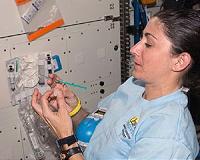
An investigation is stemming out of this world, planting an interest in students in more than a hundred schools across the nation. In the Plants in Space project, the students are studying root growth - in their classrooms, and comparing their results with those of plants grown in space onboard the International Space Station. Findings from this experiment will help determine the best ways astronauts can grow their own food during long-distance flights. On Sept. 20, Japanese astronaut Satoshi Furukawa planted Brassica rapa seeds - commonly known as a turnip mustard - in a clear, nutrient-filled gelatin in the Commercial Generic Bioprocessing Apparatus, located in the EXpedite the PRocessing of Experiments to Space Station - or EXPRESS - rack. Photographic images of root growth of the space station plants will be taken for five days and archived online so students can see the progress. "From experience with seed germination studies, we have found that some seeds are more difficult to grow than others in space," said Stefanie Countryman, a principal investigator for this experiment at BioServe Space Technologies at the University of Colorado in Boulder "We tested several seeds before settling on the Brassica seed, also known as the Wisconsin Fast Plant. We chose this because they have been grown in space previously so we know that germination should quickly occur, and teachers have easy access to the seeds and information about them." The planting is the first of four scheduled five-day trials. "For each planting, there will be 18 seeds planted - three to a container, six containers planted each time," said Countryman. "The plantings will be done about one week apart. The experiment only examines the early stage of seed germination, so this should be sufficient time to examine this stage of growth. After five days in ground tests, the plant has basically outgrown its pot. This is OK because we are only examining early growth, specifically the direction of root/shoot growth," she said. Here on Earth, roots grow in the direction of gravitational pull, while light affects the direction in which leaves grow. However, in space plant roots can grow in any direction because of the absence of gravity. This project aims to determine if light alone, without gravity, can influence the direction of root growth in microgravity. Using similar growing conditions, students will make daily observations to compare plants in normal gravity with those in space. "Plants have a significant gravitropic response - growth movement in response to gravity," said Countryman. "If humans were ever to live for extended periods of time in space, it is possible they would need to grow some of their food supply. Understanding mechanisms of seed germination without gravity is key to growing plants successfully in a low- or limited-gravity environment." "The greatest value of this set of experiments could be its impact on young minds and the direction those students may take in the future," said Dr. Nancy Moreno, principal investigator for the National Space Biomedical Research Institute Education and Outreach Program in Houston. "This project provides an opportunity for students, particularly in middle and high school, to use some of the life sciences knowledge they have already learned." The National Space Biomedical Research Institute is funding the project, conducted in cooperation with Baylor College of Medicine in Houston, BioServe Space Technologies and NASA. The teacher's guide, project information, a "how-to" video and project imagery can be accessed at Related Links National Space Biomedical Research Institute Space Tourism, Space Transport and Space Exploration News
|
. |
|
| The content herein, unless otherwise known to be public domain, are Copyright 1995-2011 - Space Media Network. AFP and UPI Wire Stories are copyright Agence France-Presse and United Press International. ESA Portal Reports are copyright European Space Agency. All NASA sourced material is public domain. Additional copyrights may apply in whole or part to other bona fide parties. Advertising does not imply endorsement,agreement or approval of any opinions, statements or information provided by Space Media Network on any Web page published or hosted by Space Media Network. Privacy Statement |

 del.icio.us
 Digg
Digg Reddit
 Google