
 |
 |
 |
 |
 |
 |
 |
 |
 |

 |

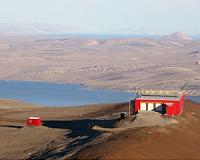
Fairbanks, Alaska (SPX) Aug 06, 2010 Permafrost warming continues throughout a wide swath of the Northern Hemisphere, according to a team of scientists assembled during the recent International Polar Year. Their extensive findings, published in the April-June 2010 edition of Permafrost and Periglacial Processes, describe the thermal state of high-latitude permafrost during the International Polar Year, 2007-2009. Vladimir Romanovsky, a professor with the snow, ice and permafrost group at the University of Alaska Fairbanks Geophysical Institute, is the lead author of the paper, which also details the significant expansion of Northern Hemisphere permafrost monitoring. "This paper is actually pretty unique," Romanovsky said, "because it's the first time such a large geographical area has been involved in one paper." During the International Polar Year, Romanovsky and his colleagues launched a field campaign to improve the existing permafrost-monitoring network. The permafrost thermal state is monitored with borehole sensors, which gather data from holes drilled deep into the permafrost. The researchers established nearly 300 borehole sites that serve as permafrost observatories across the polar and sub-polar regions in the Northern Hemisphere. Their work more than doubled the size of the previously existing network "The heart of monitoring is the measuring of temperatures in boreholes," Romanovsky said. "For permafrost temperatures, you have to be there. You have to establish boreholes." Having data from across the circumpolar North allows scientists to analyze trends affecting permafrost. The article notes that permafrost temperatures have warmed as much as two degrees Celsius from 20 to 30 years ago. They also found that permafrost near zero degrees Celsius warmed more slowly than colder permafrost. According to Romanovsky, this trend is an example of the large-scale analysis possible using data from the expanded network. The enlarged and revamped observatory network is meant to be a building block for further research. It also has the potential to foster better modeling of future conditions and act as an early warning system of the negative consequences of climate change in permafrost regions. That could, in turn, help policymakers and the public plan for a future with warmer permafrost. Romanovsky, whose specialty is Russian and North American permafrost conditions, plans to keep building on the legacy of the International Polar Year. With help from a five-year National Science Foundation grant, he continues his collaboration with American and international colleagues, establishing new borehole sites in undersampled areas and analyzing trends evidenced by the newly available data. The Fourth International Polar Year was a two-year event that began in March of 2007 and focused the attention of the international research community on the Earth's polar regions. UAF researchers were heavily involved in IPY projects and are still analyzing data from those projects.
Share This Article With Planet Earth
Related Links University of Alaska Fairbanks Climate Science News - Modeling, Mitigation Adaptation

 Climate Change By Degrees
Moffett Field CA (SPX) Aug 05, 2010 Climate change scenarios are usually summed up in terms of expected change by a certain year. Like sea levels will rise by x amount by 2020 and y amount by 2050. Or by parts per million of CO2 in the atmosphere. But because no one really knows what kind of carbon dioxide increases we're facing (that having to do with the CO2 cutting regimen we choose), the whole forecasting effort becomes ... read more |
|
|
| The content herein, unless otherwise known to be public domain, are Copyright 1995-2010 - SpaceDaily. AFP and UPI Wire Stories are copyright Agence France-Presse and United Press International. ESA Portal Reports are copyright European Space Agency. All NASA sourced material is public domain. Additional copyrights may apply in whole or part to other bona fide parties. Advertising does not imply endorsement,agreement or approval of any opinions, statements or information provided by SpaceDaily on any Web page published or hosted by SpaceDaily. Privacy Statement |


 del.icio.us
 Digg
Digg Reddit
 YahooMyWeb
 Google
 Facebook


