
 |
 |
 |
 |
 |
 |
 |
 |
 |

 |

Cambridge MA (SPX) Jul 22, 2010 The tropics owe their stunning biodiversity to consistent year-round temperatures, not higher temperatures or more sunlight, according to a novel survey of insect diversity at different latitudes and at different points in the planet's history. The finding, presented this week in the journal Paleobiology by researchers from Harvard University, Simon Fraser University, and Brandon University, may finally answer a question that has dogged scientists for centuries. It also suggests, intriguingly, that the world is likely far less diverse today than it was tens of millions of years ago, when the entire Earth had consistent year-round temperatures, much like the modern tropics. "The latitudinal diversity gradient has been recognized for 150 years as one of the most general observations in nature, and has produced more explanatory hypotheses than nearly any other observation," says co-author Brian D. Farrell, professor of biology at Harvard. "We show that when most of today's organisms were diversifying, up through the Eocene, the world lacked pronounced seasonality, more like today's tropics, even in areas where the temperature was low." "It appears it's not the heat of the tropics that promotes diversity; it's the newer seasons of the temperate zone that depress diversity." Scientists' explanations for tropical biodiversity have tended to focus on the greater heat and light found closer to the equator, and to a lesser extent the low seasonality of the tropics, where average temperature in the hottest and coolest months may vary by only a few degrees. "These factors tend to change together as you travel away from the equator toward the poles, leaving it difficult to separate their individual effects on diversity," says lead author S. Bruce Archibald, a research associate at Simon Fraser University, Harvard's Museum of Comparative Zoology, and the Royal British Columbia Museum. Archibald conducted the research for his doctoral dissertation at Harvard, where Farrell was his advisor. Farrell, Archibald, and colleagues engaged in a kind of time travel, invoking the fossil record to solve this conundrum. They compared modern insect diversity at the Harvard Forest in Petersham, Mass., and in a Costa Rican jungle against that seen at the 52.9-million-year-old McAbee fossil bed in British Columbia, noted for its exceptionally well preserved insects. At the time the McAbee fossils were created, Earth's climate was far less seasonal at all latitudes, allowing tropical species such as palm trees and crocodiles to live in what is now the high Arctic. The scientists' discovery that the ancient Canadian site's insect diversity mirrors that of the modern Costa Rican jungle, despite a marked difference in latitude, suggests that it's seasonality, not heat or light, that drives biodiversity. "Planet Earth and life have coevolved for well over a billion years, and this is yet additional evidence of the consequent intertwining of global physical and biological phenomena," Farrell says.
Share This Article With Planet Earth
Related Links Harvard University Darwin Today At TerraDaily.com

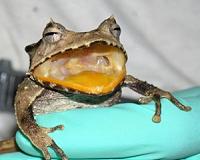 Frog Killer Caught In The Act
Washington DC (SPX) Jul 21, 2010 The first before-and-after view of an amphibian die-off has just been published by scientists working at the Smithsonian Tropical Research Institute in Panama. Like a wave, the fungal disease that wipes out frogs-chytridiomycosis-advances through the Central America highlands at a rate of about 30 kilometers per year. After the disappearance of Costa Rica's golden frogs in the 1980s, Karen ... read more |
|
|
| The content herein, unless otherwise known to be public domain, are Copyright 1995-2010 - SpaceDaily. AFP and UPI Wire Stories are copyright Agence France-Presse and United Press International. ESA Portal Reports are copyright European Space Agency. All NASA sourced material is public domain. Additional copyrights may apply in whole or part to other bona fide parties. Advertising does not imply endorsement,agreement or approval of any opinions, statements or information provided by SpaceDaily on any Web page published or hosted by SpaceDaily. Privacy Statement |


 del.icio.us
 Digg
Digg Reddit
 YahooMyWeb
 Google
 Facebook


