|
 |
 |
 |
 |
 |
 |
 |

| . |  |
. |

|
|
. |

 by Staff Writers Tokyo, Japan (SPX) Oct 10, 2011
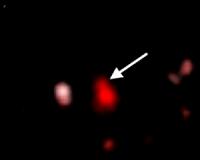
A research team of astronomers, mainly from Ehime University and Kyoto University in Japan, has successfully detected a carbon emission line (CIV1549) in the most distant radio galaxy known so far in the early universe. Using the Faint Object Camera and Spectrograph (FOCAS) on the Subaru Telescope, the team observed the radio galaxy TN J0924-2201, which is 12.5 billion light years away, and was able to measure its chemical composition for the first time. Their investigation of the detected carbon line showed that a significant amount of carbon existed as early as 12.5 billion years ago, less than a billion years after the Big Bang. This important finding contributes to our understanding of the chemical evolution of the universe and may provide clues about the chemical nature of humans, who are composed of various elements such as carbon and oxygen. Our universe began with the Big Bang, about 13.7 billion years ago. Hydrogen and helium were the only elements in this newly created universe. If these were the only elements, when and how did other elements, the so-called "metals" heavier than hydrogen and helium, originate? The answer lies in the stars shining in the night sky. Supernovae phenomena as well as nuclear fusion in stars have given rise to the variety of elements that exist today. Chemical enrichment of the universe has progressed through the birth and death of numerous stars over an immense cosmological timescale. Understanding the chemical evolution of the universe reveals a lot about the evolution of the universe itself and the sources of our human chemistry. Astronomers have studied chemical evolution by measuring the metallicity of astronomical objects at various redshifts. Metallicity refers to the abundance of elements heavier than hydrogen and helium that occur in celestial objects. Redshifts relate to how much a wavelength has been stretched by the expansion of the universe; the greater the redshift value (z) for a galaxy, the more distant it is in time and space. Therefore, measurement of the spectra of galaxies with greater redshift values provides information about the metallicity of the early universe. Radio galaxies are particularly appropriate objects for such measurements since they shine so brightly in optical as well as radio wavelengths. The current research team concentrated their efforts on measuring the metallicity of a radio galaxy at a redshift higher than had been investigated in the past. Although their previous research yielded measurements of the metallicity of radio galaxies with redshift values of less than four, their findings suggested that the main epoch of major metallicity evolution had occurred at even higher redshifts, during a much earlier time. Therefore, they focused their observations on TN J0924-2201 (Figure 1), the most distant radio galaxy known; it has a high redshift value of more than 5 (z = 5.19) and is 12.5 billion light years away. Using FOCAS on the Subaru Telescope, they obtained a deep optical spectrum of the galaxy and successfully detected, for the first time, a carbon emission line (CIV?1549) from its ionized nebula (Figure 2). It appeared that TN J0924-2201 had already experienced significant chemical evolution at z > 5. The detection of this emission line in this early galaxy confirmed their conjecture that an abundance of metals was already present in the ancient universe as far back as 12.5 billion years ago--at z > 5. The research opens the door for future investigations of the metallicity of galaxies in the early universe with redshift values of more than five. Reference: Kenta Matsuoka, Tohru Nagao, Roberto Maiolino, Alessandro Marconi, Yoshiaki Taniguchi, A and A, 532, L10, "Chemical properties in the most distant radio galaxy"
Subaru Telescope Stellar Chemistry, The Universe And All Within It
|
. |
|
| The content herein, unless otherwise known to be public domain, are Copyright 1995-2011 - Space Media Network. AFP and UPI Wire Stories are copyright Agence France-Presse and United Press International. ESA Portal Reports are copyright European Space Agency. All NASA sourced material is public domain. Additional copyrights may apply in whole or part to other bona fide parties. Advertising does not imply endorsement,agreement or approval of any opinions, statements or information provided by Space Media Network on any Web page published or hosted by Space Media Network. Privacy Statement |

 del.icio.us
 Digg
Digg Reddit
 Google