
 |
 |
 |
 |
 |
 |
 |
 |
 |

 |

Science@NASA Washington DC (SPX) Nov 19, 2010 Prompted by a recent increase in solar activity, more than a hundred researchers and government officials are converging on Helwan, Egypt, to discuss a matter of global importance: storms from the sun. The "First Workshop of the International Space Weather Initiative (ISWI)" meets Nov. 6th through 10th and is convened by the United Nations, the National Aeronautics and Space Administration (NASA), and the Japan Aerospace Exploration Agency (JAXA). "Strong solar storms can knock out power, disable satellites, and scramble GPS," says meeting organizer and ISWI executive director Joe Davila of NASA's Goddard Space Flight Center. "This meeting will help us prepare for the next big event." A key problem organizers hope to solve is a gap--many gaps, actually---in storm coverage around our planet. When a big storm is underway, waves of ionization ripple through Earth's upper atmosphere, electric currents flow through the topsoil, and the whole planet's magnetic field begins to shake. "These are global phenomena," says Davila, "so we need to be able to monitor them all around the world." Industrialized countries tend to have an abundance of monitoring stations. They can keep track of local magnetism, ground currents, and ionization, and provide the data to researchers. Developing countries are where the gaps are, particularly at low latitudes around Earth's magnetic equator. Although space weather is usually associated with Earth's polar regions--think, "Northern Lights"--the equator can be just as interesting. For example, there is a phenomenon in Earth's upper atmosphere called the "equatorial anomaly." It is, essentially, a fountain of ionization that circles the globe once a day, always keeping its spout toward the sun. During solar storms, the equatorial anomaly can intensify and shape-shift, bending GPS signals in unexpected ways and making normal radio communications impossible. "International cooperation is essential for keeping track of the equatorial anomaly," he adds. "No single country can do it alone." It's no coincidence that the inaugural meeting of the ISWI is being held in Egypt, an equatorial country. Of 30 nations sending representatives to the ISWI, more than two-thirds are clustered around the magnetic equator. This could lead to a revolution in studies of low-latitude space weather. here is much to do beyond the equator, too. During the meeting, researchers and students will learn how they can set up monitoring stations for cosmic rays, ground currents, magnetic storms, and auroras. There's a phenomenon for every latitude and level of expertise. "We are offering a whole buffet of research opportunities," says Davila. Researchers who miss the first meeting will get many more chances. The International Space Weather Initiative is an ongoing program with get-togethers planned on an annual basis at different spots around the world. The next meeting will be held in Nigeria in November 2011. No country is too remote, too small, or too poor to participate. Indeed, notes Davila, "the smallest most out of the way places are often where data are needed most. Everyone is invited."
Share This Article With Planet Earth
Related Links International Space Weather Initiative Solar Science News at SpaceDaily

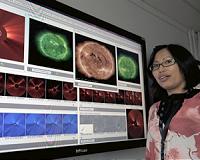 Yihua Zheng: A New Breed Of Weather Forecaster
Greenbelt MD (SPX) Nov 17, 2010 It is 11:15 a.m. on a Friday morning at NASA's Goddard Space Flight Center in Greenbelt, Md. and time for Yihua Zheng's daily check on the sun. She walks from her small office down the hall to the Community Coordinated Modeling Center - a room much more dynamic and colorful than its name suggests. Four large plasma screens on the wall show colorful basketball-sized images of the sun in rea ... read more |
|
|
| The content herein, unless otherwise known to be public domain, are Copyright 1995-2010 - SpaceDaily. AFP and UPI Wire Stories are copyright Agence France-Presse and United Press International. ESA Portal Reports are copyright European Space Agency. All NASA sourced material is public domain. Additional copyrights may apply in whole or part to other bona fide parties. Advertising does not imply endorsement,agreement or approval of any opinions, statements or information provided by SpaceDaily on any Web page published or hosted by SpaceDaily. Privacy Statement |


 del.icio.us
 Digg
Digg Reddit
 YahooMyWeb
 Google
 Facebook


