
 |
 |
 |
 |
 |
 |
 |
 |
 |

 |

Moffett Field CA (SPX) Mar 15, 2011 Which species may be most adept to climate change? The answer could very well be microbes. The microscopic critters do something that no other living thing is capable of: long term dormancy. As Jay Lennon from Michigan State University explains in his latest paper, "Microbial seed banks: the ecological and evolutionary implications of dormancy" in Nature Reviews: Microbiology, when the going gets rough, microbes can just check out and wait for better times. "There's this transition region between life and death and maybe this is how it relates to undead and zombie- like organisms," Lennon says in a video about his work. Microbes are the undead of the living world, as they tend to exist in this in-between state for a good part of the time. In soils, about 90 percent of the microbes are dormant, and nearly half the species, Lennon points out. Though they're not active, the microbes still add to the genetic pool and are available as a population boost when necessary, contributing to what Lennon calls "microbial seed banks." These dormant species can revive in new conditions, lending to the adaptability of microbes in a changing world. Lennon points out that there is a cost to be a zombie-like. They need special genes and functions to enter into and out of the undead, and in dormancy they still require some energy to keep molecules in a good state of repair so that DNA doesn't degrade. But all in all, microbes seem to do well by the strategy. Lennon says these dormant microbes may have an important role to play in climate change, since microbes in general can impact the release of carbon in to the atmosphere through metabolizing elements in the soil. "When we think about climate change, microbes are pretty integral to the whole process and understanding what's going to happen under climate change scenarios," he says. Lennon adds, "This fundamentally changes the way we think about the contribution of microorganisms to global bio-geo-chemical cycles and potentially how systems would change under shifting climate regimes." More research is needed to understand the exact impacts. Here's a video of Lennon talking about his research into microbes. Invasive species can trigger mass extinction Invasive species are becoming more rampant today as a result of climate change and other factors. Changes in precipitation and temperature patterns often favor invasives, which have an uncanny ability to adapt and spread in stressed ecosystems. A new study shows how invasives can actually trigger a mass extinction similar, perhaps, to what we're seeing under modern day biodiversity loss. Geologist Alycia Stigall at Ohio University explored the late Devonian extinction, one of five mass extinctions in Earth history about 378 to 375 million years ago. During the Devonian, sea levels rose and two continents, Euramerica and Gondwana, closed in to form the single land mass of Pangea. In the process, certain species gained access to new ecosystems, thriving in ways that out-competed the natives. Stigall claims that the extinction rate during the late Devonian was actually not all that different than background levels. Instead, she looks at the loss of species from the standpoint of speciation. In other words, the creation of new species through subdivisions in populations and dispersals to new territories. Examining the lifeline (or clade) of three types of shelled invertebrates and a predatory crustacean, she found that the creation of new species through subdivisions in the population - called vicariance - was almost non-existent during this time period. This is unusual compared to other geologic periods and points to the invasion of certain species as the cause for biodiversity loss in the Devonian, she claims. As species went extinct, no daughter species filled the ecological niches left open. Stigall writes that modern day extinctions may be the result of a similar situation as human-induced invasive species take over ecosystems leaving few opportunities for natives to adapt.
Share This Article With Planet Earth
Related Links Michigan State University Climate Science News - Modeling, Mitigation Adaptation

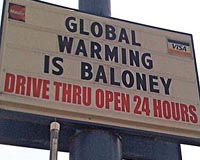 Fewer Americans worry about climate change: poll
Washington (AFP) March 14, 2011 The number of Americans who are worried about global warming has fallen to nearly the historic low reached in 1998, a poll released Monday showed. Just 51 percent of Americans - or one percentage point more than in 1998 - said they worry a great deal or fair amount about climate change, Gallup's annual environment poll says. In 2008, a year after former US vice president Al Gore and t ... read more |
|
|
| The content herein, unless otherwise known to be public domain, are Copyright 1995-2010 - SpaceDaily. AFP and UPI Wire Stories are copyright Agence France-Presse and United Press International. ESA Portal Reports are copyright European Space Agency. All NASA sourced material is public domain. Additional copyrights may apply in whole or part to other bona fide parties. Advertising does not imply endorsement,agreement or approval of any opinions, statements or information provided by SpaceDaily on any Web page published or hosted by SpaceDaily. Privacy Statement |


 del.icio.us
 Digg
Digg Reddit
 YahooMyWeb
 Google
 Facebook


