
 |
 |
 |
 |
 |
 |
 |
 |
 |

 |

Washington DC (SPX) Aug 06, 2010 Step outside as evening twilight fades, and from now through the middle of August you'll find three planets shining low in the west - one much brighter than the other two. All you'll need is a clear sky and an open westward view about an hour after sunset. "Venus will leap out at you," says Alan MacRobert, a senior editor of Sky and Telescope magazine. "Saturn and Mars are fainter, so you may need to wait for the sky to darken a bit more before they glimmer into view." Venus is the famed "Evening Star," the brightest celestial object in Earth's sky after the Sun and Moon. Saturn and Mars are only about 1 percent as bright. They form a more-or-less horizontal line above Venus, as wide as three or four fingers held together at arm's length. Saturn and Mars will spend the week sliding to the right with respect to Venus, creating a planetary triangle that changes shape from day to day. Although the three planets look close together, they're not. Venus is currently 6 light-minutes (73 million miles) from us, Mars is 17 light-minutes (190 million miles) distant, and Saturn is far in the background 85 light-minutes (950 million miles) away. Three reasons combine to make Venus shine so much brighter than the others. It's the closest to us, it's the closest to the Sun so it's illuminated more intensely, and it's covered with brilliantly reflective white clouds. As for Mars and Saturn? They look similar in brightness for reasons that cancel out. Saturn is 35 times larger than Mars, but it's much farther both from us and from the Sun. The crescent Moon joins the twilight planet scene on Thursday, August 12th (when it's below Venus) and Friday the 13th (when it's left of Venus). "Don't miss this chance to do some easy astronomy from your backyard, balcony, or rooftop," says Sky and Telescope editor in chief Robert Naeye. "It's a big universe, and planets await!" For more skywatching information and astronomy news, visit SkyandTelescope.com or pick up Sky and Telescope, the essential magazine of astronomy since 1941.
Share This Article With Planet Earth
Related Links Sky and Telescope magazine Astronomy News from Skynightly.com

 From Stone Age To Space Age
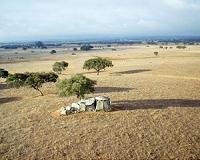
Paris, France (SPX) Aug 05, 2010 The UNESCO World Heritage Committee, at its 34th session in Brasilia, Brazil, has, for the first time, endorsed a study in science heritage. The thematic study on the Heritage Sites of Astronomy and Archaeoastronomy, prepared within the framework of the International Year of Astronomy 2009, presents an overall vision of astronomical heritage and attempts to identify some of the most outsta ... read more |
|
|
| The content herein, unless otherwise known to be public domain, are Copyright 1995-2010 - SpaceDaily. AFP and UPI Wire Stories are copyright Agence France-Presse and United Press International. ESA Portal Reports are copyright European Space Agency. All NASA sourced material is public domain. Additional copyrights may apply in whole or part to other bona fide parties. Advertising does not imply endorsement,agreement or approval of any opinions, statements or information provided by SpaceDaily on any Web page published or hosted by SpaceDaily. Privacy Statement |


 del.icio.us
 Digg
Digg Reddit
 YahooMyWeb
 Google
 Facebook


