
 |
 |
 |
 |
 |
 |
 |
 |
 |

 |

Greenbelt MD (JPL) Oct 29, 2010 Two NASA spacecraft have been assigned a new mission after successfully completing their original science objectives earlier this year. The duo began making observations this week to study how solar wind electrifies, alters and erodes the Moon's surface. Data could reveal valuable information for future explorers and give planetary scientists a hint of what's happening on other worlds around the solar system. The new mission is called ARTEMIS, or Acceleration, Reconnection, Turbulence and Electrodynamics of Moon's Interaction with the Sun. ARTEMIS uses two of five in-orbit spacecraft from NASA's THEMIS, or Time History of Events and Macroscale Interactions during Substorms, mission. "Using two repurposed satellites for the ARTEMIS mission highlights NASA's efficient use of the nation's space assets," said Dick Fisher, director of the Heliophysics Division in NASA's Science Mission Directorate at the agency's headquarters in Washington. ARTEMIS will measure solar wind turbulence on scales never sampled by previous missions. Solar wind is a stream of charged particles emitted from the upper atmosphere of the sun. "ARTEMIS will provide a unique two-point view of the Moon's under-explored space environment," said Vassilis Angelopoulos of the University of California in Los Angeles (UCLA), principal investigator of the THEMIS mission. "These two spacecraft are headed for an incredible new adventure." One ARTEMIS spacecraft reached what is called the L2 Lagrange point on the far side of the Moon on Aug. 25. On Oct. 22, the other spacecraft entered the L1 Lagrange point on the Earth-side of the Moon. Lagrange points are places where the gravity of Earth and Moon balance, creating a sort of gravitational parking spot for spacecraft. NASA repositioned the two outermost THEMIS spacecraft using spare on-board fuel and a set of complex orbit maneuvers over the course of more than a year. "ARTEMIS is going where no spacecraft have gone before," said Manfred Bester, Mission Operations manager from the University of California at Berkeley, where the spacecraft are operated. "We are exploring the Earth-Moon Lagrange points for the first time." After six months at the Lagrange points, ARTEMIS will move closer to the Moon. The spacecraft will be approximately 62 miles from the surface at first, but will eventually move closer. From point-blank range, the spacecraft will look to see how the solar wind impacts a rocky world when there's no magnetic field to protect it. Earth is protected from solar wind by its magnetic field. However, the Moon is exposed because it has no global magnetism. The ARTEMIS mission is a joint effort among NASA's Goddard Space Flight Center in Greenbelt, Md.; NASA's Jet Propulsion Laboratory in Pasadena, Calif.; the Space Sciences Laboratory at Berkeley; and UCLA. Launched in 2007, THEMIS was NASA's first five-satellite mission launched aboard a single rocket. The unique constellation of satellites provided scientists with data to help resolve the mystery of how Earth's magnetosphere stores and releases energy from the sun by triggering geomagnetic substorms. The three remaining THEMIS satellites continue to study substorms that are visible in the Northern Hemisphere as a sudden brightening of the Northern Lights, or aurora borealis. The mission was one of NASA's series of low-cost, rapidly developed missions in the Explorers Program. ATK, formerly Swales Aerospace, in Beltsville, Md., built the THEMIS probes. Goddard manages the program for the agency's Science Mission Directorate.
Share This Article With Planet Earth
Related Links ARTEMIS THEMIS Space Technology News - Applications and Research

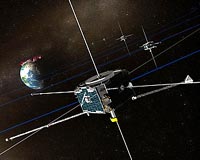 ARTEMIS Spacecraft Believed Stuck By Object
Pasadena CA (JPL) Oct 25, 2010 Flight Dynamics data from THEMIS-B (one of the two ARTEMIS spacecraft) indicated that one of the EFI (electric field instrument)spherical tip masses may have been struck by a meteoroid at 0605 UT on October 14. All science instruments continue to collect data. The probe and science instruments aboard the spacecraft continue to operate nominally. The upcoming insertion into Lissajous orbit ... read more |
|
|
| The content herein, unless otherwise known to be public domain, are Copyright 1995-2010 - SpaceDaily. AFP and UPI Wire Stories are copyright Agence France-Presse and United Press International. ESA Portal Reports are copyright European Space Agency. All NASA sourced material is public domain. Additional copyrights may apply in whole or part to other bona fide parties. Advertising does not imply endorsement,agreement or approval of any opinions, statements or information provided by SpaceDaily on any Web page published or hosted by SpaceDaily. Privacy Statement |


 del.icio.us
 Digg
Digg Reddit
 YahooMyWeb
 Google
 Facebook


