
 |
 |
 |
 |
 |
 |
 |
 |
 |

 |

London (UPI) Feb 28, 2011 British scientists say they will lead a $650 million program searching for chemical signs of life on planets orbiting distant stars. Researchers at University College London are at the head of the Exoplanet Characterization Observatory mission, backed by the European Space Agency, that will use a new space telescope to look for biomarkers in the atmospheres of exoplanets, The Independent reported Monday. They will search for molecules of chemicals that may indicate the presence of life, they say. "One of the key aims of our mission is to see if we can detect molecules such as ozone and carbon dioxide in the atmospheres of planets not much bigger than Earth," head UCL researcher Giovanni Tinetti said. "These molecules are key biomarkers -- signs that life might be, or might have been, present." The EChO mission will focus on Earth-sized planets in the "habitable zone" of Sun-like stars, also known as the "Goldilocks zone, the region where conditions are not too hot and not too cold but "just right" to allow the existence of liquid surface water. The EChO space telescope is scheduled to be launched between 2020 and 2022. ESA's decision to back the mission follows discoveries made NASA's Kepler space telescope. Earlier this month, Kepler scientists announced a new tally of 1,235 planet "candidates" orbiting stars beyond the Sun, including 54 potential "habitable zone" planets, five of which were Earth-sized.
Share This Article With Planet Earth
Related Links Life Beyond Earth Lands Beyond Beyond - extra solar planets - news and science

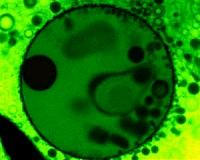 Clay-Armored Bubbles May Have Formed First Protocells
Cambridge, MA (SPX) Feb 23, 2011 A team of applied physicists at Harvard's School of Engineering and Applied Sciences (SEAS), Princeton, and Brandeis have demonstrated the formation of semipermeable vesicles from inorganic clay. The research, published online this week in the journal Soft Matter, shows that clay vesicles provide an ideal container for the compartmentalization of complex organic molecules. The author ... read more |
|
|
| The content herein, unless otherwise known to be public domain, are Copyright 1995-2010 - SpaceDaily. AFP and UPI Wire Stories are copyright Agence France-Presse and United Press International. ESA Portal Reports are copyright European Space Agency. All NASA sourced material is public domain. Additional copyrights may apply in whole or part to other bona fide parties. Advertising does not imply endorsement,agreement or approval of any opinions, statements or information provided by SpaceDaily on any Web page published or hosted by SpaceDaily. Privacy Statement |


 del.icio.us
 Digg
Digg Reddit
 YahooMyWeb
 Google
 Facebook


