
 |
 |
 |
 |
 |
 |
 |
 |
 |

 |

Washington (UPI) Jul 29, 2010 The U.S. Army has placed orders with iRobot and Boeing for 94 small unmanned ground vehicles under a $14.6 million contract announced this week. Under the deal the companies will provide the Army with new 310 models, plus spare parts. The 35-pound unmanned robots, said Bob Dalee, robotics program manager for Boeing Network and Tectical Systems, are capable of providing the "dismounted explosive ordinance disposal technician with the ability to perform reconnaissance during extremely hazardous ... missions involving unexploded ordinance and improvised explosive devices," a company statement said. The order is the Army's fifth related contract, amassing a total of 323 units. Boeing and iRobot have been working together, developing unmanned vehicles since 2007. The particular order for the more advanced robotic vehicles includes smaller and lighter models of the iRobot PackBot. A Boeing statement prides the vehicles as "designed to give warfighters real-time awareness of critical situations and carry out missions from safe standoff distances." "Robots have played an important role on the battlefield for years now and their numbers in theater are growing," said Joe Dyer, president of iRobot's Government and Industrial Robots division, according to a report by DefenseTalk. "Warfighters can carry and quickly deploy the small unmanned ground vehicle at a moment's notice, which is crucial in challenging environments such as Afghanistan. These robots are saving lives every day." The order follows a fresh tender by the U.S. Army for the development of new ground combat vehicles as part of efforts to counter crude bombs used by Taliban forces in Afghanistan. The need for such equipment also comes at a time when U.S.-led forces in Afghanistan have intensified combat operations against Taliban insurgents who have equally been increasing their attacks against foreign troops. More than 100 soldiers died in June, the highest monthly death toll for the 9-year war. In one attack alone, last month, four Americans were killed by a roadside bomb. Such bombs, known as improvised explosive devices, have become the main weapon used against international and Afghan forces fighting to end an insurgency by Taliban elements. The small, unmanned vehicles can "increase the safety of U.S. and allied warfighters in uncertain situations," said William Boggs, director of Boeing Global Forces & Robotics Systems, said a Boeing statement. As the prime contractor, Boeing will co-develop the vehicles in iRobot's headquarters in Bedford, Mass. The number of improvised explosive devices in the country has risen relentlessly, up from about 50 a week during the summer of 2007. In the last week of June, military officials say they counted 300 crude bombs that either exploded or were spotted in their field of operation. In all, the crude bombs account for about two-thirds of NATO's troop fatalities.
Share This Article With Planet Earth
Related Links The latest in Military Technology for the 21st century at SpaceWar.com

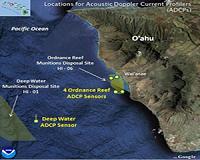 Investigation Of Military Munitions Sea Disposal Site
Honolulu HI (SPX) Jul 30, 2010 The University of Hawaii at Manoa's School of Ocean Earth Science and Technology (SOEST) completed a three-year long investigation of Sea Disposal Site Hawaii Number 5 (HI-05), a deep-water military munitions disposal site in U.S. coastal waters approximately 5 miles south of Pearl Harbor, Oahu, Hawaii. This complex investigation required the use of high-resolution sidescan sonar and remot ... read more |
|
|
| The content herein, unless otherwise known to be public domain, are Copyright 1995-2010 - SpaceDaily. AFP and UPI Wire Stories are copyright Agence France-Presse and United Press International. ESA Portal Reports are copyright European Space Agency. All NASA sourced material is public domain. Additional copyrights may apply in whole or part to other bona fide parties. Advertising does not imply endorsement,agreement or approval of any opinions, statements or information provided by SpaceDaily on any Web page published or hosted by SpaceDaily. Privacy Statement |


 del.icio.us
 Digg
Digg Reddit
 YahooMyWeb
 Google
 Facebook


