
 |
 |
 |
 |
 |
 |
 |
 |
 |

 |

Washington (AFP) July 31, 2010 The United States is close to activating a missile shield over southern Europe as part of its effort to shore up regional defenses in the face of a missile threat from Iran, The Washington Post reported late Saturday. Citing unnamed Pentagon officials, the newspaper said the US Defense Department is nearing a deal to establish a key radar ground station probably in Turkey or Bulgaria. Installation of the high-powered X-band radar would enable the first phase of the shield to become operational next year, the report said. In September 2009, US President Barack Obama scrapped a missile shield project, which had been pushed by his predecessor George W. Bush and would have seen a powerful radar installed in the Czech Republic and 10 long-range ballistic interceptor missiles in Poland by 2013. The shield plan had enraged Russia, which called it a security menace on its doorstep, although Washington insisted the aim was to ward off a potential long-range missile threat from Iran. But according to The Post, a plan to protect southern Europe from missiles is still being implemented. The US military is also working with Israel and allies in the Persian Gulf to build and upgrade their missile defense capabilities, the report said. The United States installed a radar ground station in Israel in 2008 and is looking to place another in an Arab country in the gulf region, the paper said. The radars would provide a critical early warning of any launches from Iran, according to The Post. The missile defenses in Europe, Israel and the Gulf are technically separate and in different stages of development, the paper said. But they are all designed to plug into command-and-control systems operated by, or with, the US military, The Post pointed out. The Israeli radar is operated by US personnel, and it is already providing information to US Navy ships in the Mediterranean, the paper noted.
earlier related report "There is a plan to grant two million dollars in 2011-12 for the creation of a central shared early warning system, in the budget debate in the two houses of (US) Congress," he said during a press briefing in Prague. Necas said at issue was a "technical-administrative" centre aimed at "detecting the launch of missiles against the territory of the Atlantic alliance." "Right now, it is a bilateral issue, but it is assumed that this system will be part of NATO's missile defence," the head of the Czech government said. Necas said it is likely that the centre could be located "in Prague or surrounding areas", but that "details will be negotiated later." A team of Czech experts at the centre would check data coming from different satellites, Necas said. Czech Defence Minister Alexandr Vondra told the Czech CTK news agency the system would be passive without any capacity for missile launch. In Bratislava, Slovakia's Foreign Minister Mikulas Dzurinda said Friday that his country was also ready to participate in the project. "If this project ... in which the Czech Republic should be included, leads to greater security, we will say 'yes' unequivocally," he said during a news conference. In September 2009 US President Barack Obama scrapped a missile shield project, which had been pushed by his predecessor George W. Bush and would have seen a powerful radar installed in the Czech Republic and 10 long-range ballistic interceptor missiles in Poland by 2013. Surveys showed some 70 percent of Czechs had disapproved of the plan. The shield plan had enraged Russia, which called it a security menace on its doorstep, although Washington insisted the aim was to ward off a potential long-range missile threat from Iran. "No to bases", an alliance that had protested the original missile shield, on Friday in Prague said it was also opposed to the new project.
Share This Article With Planet Earth
Related Links Learn about missile defense at SpaceWar.com Learn about nuclear weapons doctrine and defense at SpaceWar.com All about missiles at SpaceWar.com Learn about the Superpowers of the 21st Century at SpaceWar.com

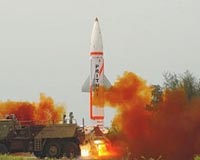 India's defense shield tested
New Delhi (UPI) Jul 27, 2010 Following a failed test earlier this year, India's fledgling ballistic missile defense system has run a successful launch, military officials say. The successful test marks a significant step in India's bid to build a fully operation missile shield for key areas and installations in its terrain. India's Defense Research and Development Organization said that a Prithvi interceptor ... read more |
|
|
| The content herein, unless otherwise known to be public domain, are Copyright 1995-2010 - SpaceDaily. AFP and UPI Wire Stories are copyright Agence France-Presse and United Press International. ESA Portal Reports are copyright European Space Agency. All NASA sourced material is public domain. Additional copyrights may apply in whole or part to other bona fide parties. Advertising does not imply endorsement,agreement or approval of any opinions, statements or information provided by SpaceDaily on any Web page published or hosted by SpaceDaily. Privacy Statement |


 del.icio.us
 Digg
Digg Reddit
 YahooMyWeb
 Google
 Facebook


