
 |
 |
 |
 |
 |
 |
 |
 |
 |

 |

Caracas, Venezuela (UPI) Nov 19, 2010 Venezuela's recession-hit economy is on the mend but the ravages of drought, nationalizations and slow growth have combined to make a further devaluation of the bolivar inevitable in 2011, industry analysts said. Figures cited by the International Monetary Fund and industry experts suggested a formal revision of the bolivar-U.S. dollar parity would make official what is already in effect in Venezuela's burgeoning informal economy. Venezuela last devalued its currency in January 2010. Venezuela emerged from last year's economic troubles, aftermath of the 2008 economic downturn, as the only major Latin American country to report a shrinking economy. Amid an array of financial statistics still hotly contested by critics of President Hugo Chavez and his opposition foes, plus independent economists, published financial analyses of Venezuela's economic performance showed the worst might just be over for the country -- at least for now. A spate of nationalization measures, rushed through by Chavez before, during and after a crippling drought affected growth that also received a battering from electricity and water shortages through much of 2009 and early 2010. Barclays Capital said in a report it was told by Central Bank and other officials devaluation would mean the government would sell dollars at official rates of 3 and 5 bolivars per dollar, instead of the current rates of 2.6 and 4.3 bolivars in force since January. Opposition critics of Chavez said the government's draconian measures against the industry had caused a flight of capital from Venezuela that could be continuing. On the positive side growth figures showed the economy contracted less than expected and found some relief in increased public spending. Venezuela is having to cope with a decline in its petroleum production, partly the result of vast nationalization measures that left industry institutions without skilled workers in strategic places. IMF comments on the economy's state are mild when compared to critics' pronouncements. The economy shrank 3.1 percent in 2009 and this year's IMF forecast of 1.3 percent contraction could still be up for revision by the yearend, analysts said. The government's populist measures against business and industry sliced off major chunks of anticipated production and waves of nationalization took a further toll. The government is fighting battles with both domestic and international investors who have been affected by a series of series. Chavez frequently challenges economists who maintain the country is in crisis. The economic performance has raised fears Chavez may lose grip on power, a scenario that was met with defiant government warnings that any opposition moves to unseat the president or subvert his Bolivarian revolution would attract tough response, including military intervention on behalf of Chavez. In contrast, Chile, Peru and Uruguay ranked as the countries with the best business climate, a study by the Brazilian Getulio Vargas Foundation said. The foundation study ranked Chile with 7.5 points, Peru at 7.1, Uruguay at 7, Brazil at 6.8, Colombia at 6.8, Paraguay at 6.5, Argentina at 5.9 and Bolivia at 5.6. The Getulio Vargas Foundation for promoting exemplary business administration was founded in 1954 as a privately funded independent think tank. The foundation was a posthumous tribute to Brazil's colorful former dictator and modernizer, Getulio Dornelles Vargas, equally noted for his authoritarian and constructive role in Brazil between the two world wars and in the early 1950s.
Share This Article With Planet Earth
Related Links Global Trade News

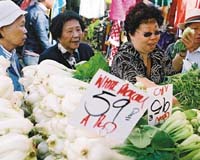 Chinese consumers blame US as prices spiral up
Beijing (AFP) Nov 18, 2010 At a bustling outdoor fruit and vegetable market in Beijing, Zhan Tiehui grumbles about rising prices for garlic, ginger and cabbage and points a stubby finger in the direction of the United States. "The source of China's inflation is America, they are printing too much money," Zhan, 50, told AFP as she clutched plastic bags full of vegetables. "Everything is definitely more expensive th ... read more |
|
|
| The content herein, unless otherwise known to be public domain, are Copyright 1995-2010 - SpaceDaily. AFP and UPI Wire Stories are copyright Agence France-Presse and United Press International. ESA Portal Reports are copyright European Space Agency. All NASA sourced material is public domain. Additional copyrights may apply in whole or part to other bona fide parties. Advertising does not imply endorsement,agreement or approval of any opinions, statements or information provided by SpaceDaily on any Web page published or hosted by SpaceDaily. Privacy Statement |


 del.icio.us
 Digg
Digg Reddit
 YahooMyWeb
 Google
 Facebook


